A small hatchback can make more sense than a large SUV when most of your driving is around Gaborone. It is easier to park, usually lighter on fuel and simpler to live with every day.
The harder question is the final cost. A Japan-import price is not the same as the registered amount in Botswana. Model year, hybrid equipment, auction grade and condition also change the value. This guide explains the Toyota Yaris price in Botswana, official Japanese fuel figures, reliability checks and the situations where a larger vehicle makes more sense. For broader background, see this Toyota Yaris background guide.
Quick Answer
- The Toyota Yaris suits Gaborone commuting, errands and small households.
- In 2020, Toyota listed the Japanese-market Yaris Hybrid X at up to 36.0 km/L under WLTC testing (Toyota Global Newsroom, “New Yaris”, 2020).
- A dated listing snapshot places relevant vehicles from the mid-P100,000 range to the low-P200,000 range.
- Botswana has no general motor-vehicle import age restriction, but older cars need closer checks.
- The vehicle price is not the final registered or on-road cost.
How much does a Toyota Yaris cost in Botswana?
The broad BWP planning bands below are based on a dated Carbarn Japan-stock snapshot, not a Botswana-wide market average or a direct currency conversion. The first-party Toyota Yaris Price in Botswana | Japan Stock page dated 4 September 2026 showed 2020-2023 vehicles and odometers from 34,000 to 119,000 kilometres. Check the vehicle page’s original listing currency and estimated landed-cost panel before relying on any figure. Check the vehicle page’s original listing currency and estimated landed-cost panel before relying on any figure.
Price depends on the exact model. Hybrid versions, newer cars, lower odometer readings and stronger auction grades may sit higher. Older Vitz or Yaris models can cost less, but age-related wear may reduce the saving after tyres, suspension, battery or electrical work.
The page groups standard Yaris and Yaris Cross entries under related filters, so compare the body style carefully. A hatchback and an SUV-shaped Yaris Cross are not interchangeable when judging price, space or ground clearance.
The published vehicle package covers the vehicle, shipping and inspection. It does not cover customs duty, VAT, clearance, registration or licensing. CIF means cost, insurance and freight. Customs duty depends on the vehicle’s tariff classification and customs valuation, so BURS should confirm the applicable rate before payment.
| Vehicle type and buyer profile |
Useful BWP planning guide |
| Older, value-focused standard Yaris |
Mid-P100,000 range |
| Mid-range hybrid standard Yaris |
P150,000-P200,000 range |
| Newer or higher-grade standard Yaris |
Around P200,000 or above |
| Yaris Cross |
Compare separately; body style and specification can place it in a different band |
Editorial BWP planning bands based on a dated Carbarn Japan-stock snapshot, including Yaris Cross entries. No exchange-rate conversion is claimed. They are not registered Botswana retail prices, and exclude customs duty, VAT, clearance, registration and licensing. Prices change with year, mileage, grade, drivetrain and market conditions.
Toyota Yaris versions for Botswana buyers
The standard Yaris is a compact hatchback, while the Yaris Cross offers a higher driving position and SUV body. Toyota’s Japanese-market generation launched on 10 February 2020 on the GA-B version of its TNGA platform (Toyota Global Newsroom, “New Yaris”, 2020). Your road conditions, passengers and parking needs should decide the model.
Standard Toyota Yaris hatchback
The Toyota Yaris hatchback is the better fit for town driving, tight parking spaces and smaller households. Its compact size works well for errands, commuting and paved inter-town travel. It is less convincing if you regularly carry several adults, heavy cargo or travel on rough roads.
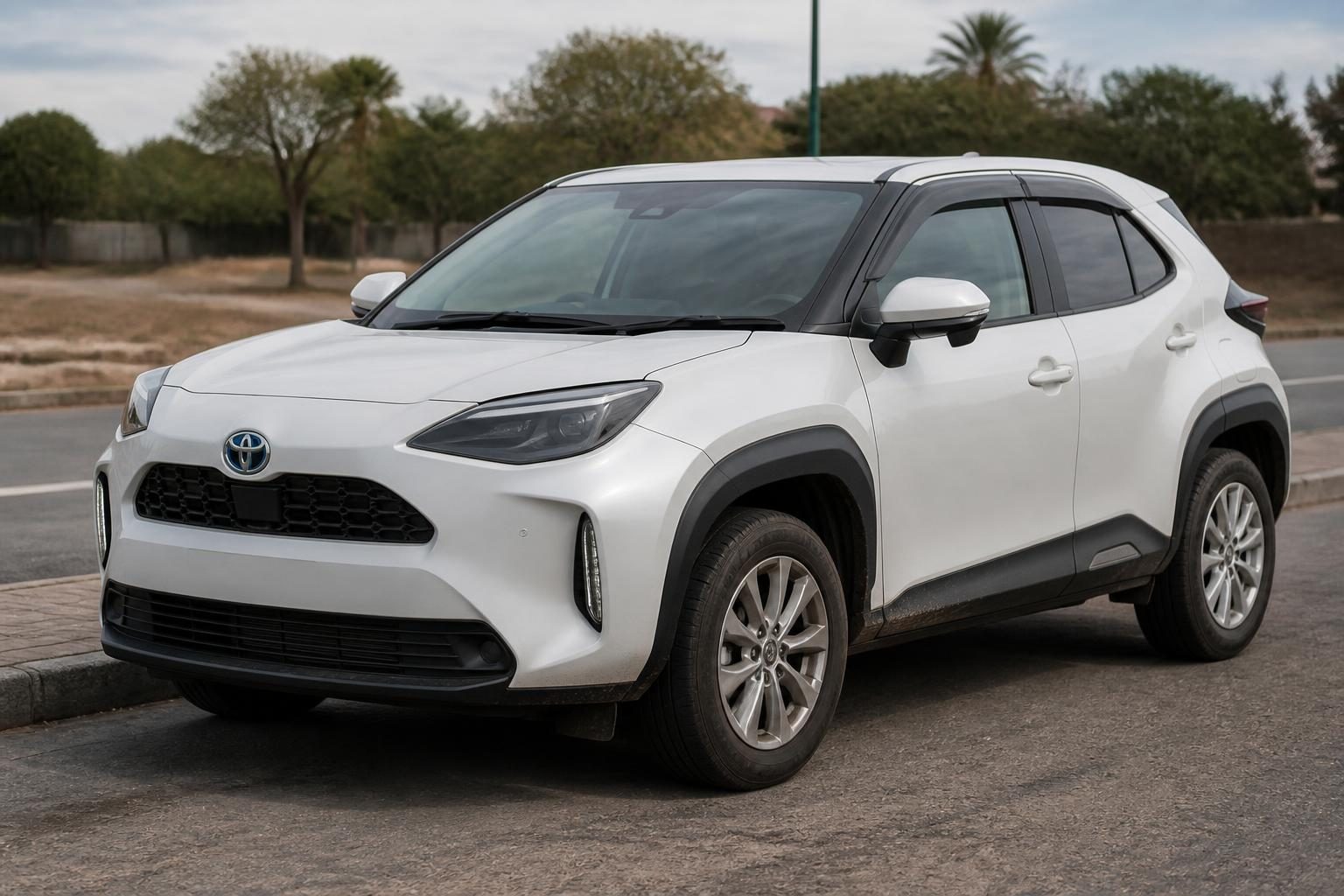 2020 TOYOTA yaris cross
A documented 2023 hybrid example records a 1,500 cc M15A-FXE engine rated at 67 kW / 91 PS, front-wheel drive, automatic transmission and five seats. Toyota’s Japanese catalogue confirms the 67 kW / 91 PS rating (Toyota Japan, “Yaris catalogue”, 2020). Its listed dimensions are 3,940 mm long, 1,695 mm wide and 1,500 mm high, with a 2,550 mm wheelbase (2023 Toyota Yaris vehicle page, 2026). The exact grade and equipment still need checking on each vehicle page.
Toyota Yaris Cross comparison
The Toyota Yaris Cross is a separate SUV-style model, not a taller version of the standard hatchback. It makes more sense if you want a higher seating position, easier entry and more visual confidence on uneven urban roads.
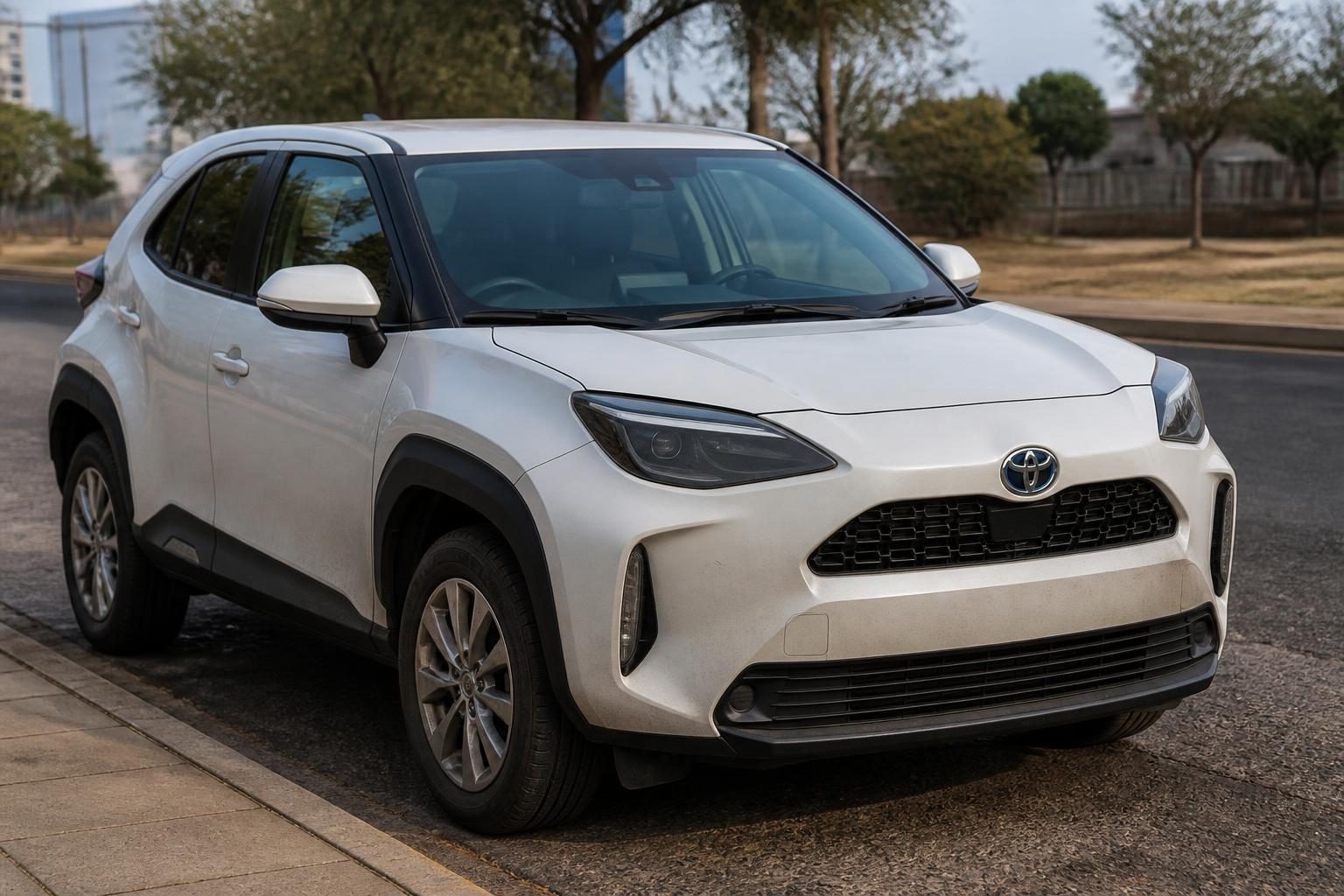 2020 TOYOTA yaris cross
The confirmed comparison example is a 2020 hybrid with 34,000 kilometres, auction grade 4.5 and model code MXPJ10. It has a 1,500 cc engine rated at 67 kW / 91 PS, automatic CVT, 2WD and five seats. Toyota’s Japanese catalogue confirms the Yaris Cross dimensions of 4,180 mm by 1,765 mm by 1,590 mm (Toyota Japan, “Yaris Cross catalogue”, 2020); the vehicle page provides the example details (2020 Toyota Yaris Cross vehicle page, 2026).
| Buyer priority |
Standard Yaris |
Yaris Cross |
| Gaborone commuting |
Strong fit |
Strong fit |
| Easy parking |
Strongest fit |
Good |
| Higher seating position |
Limited |
Stronger |
| Uneven roads |
Limited |
Better suited |
| Small household |
Strong fit |
Strong fit |
| Heavy loads or large families |
Limited |
Still limited |
Is the Toyota Yaris fuel-efficient enough for Botswana?
Yes, especially in hybrid form. In 2020, Toyota’s Japanese-market launch release listed the Yaris Hybrid X at 36.0 km/L under WLTC testing, with separate city, suburban and highway results (Toyota Global Newsroom, “New Yaris”, 2020). Official figures are useful for comparison, not promises of real-world consumption.
Toyota Japan’s 2026 specification sheet lists selected 2WD hybrid Yaris grades between approximately 35.4 and 36.0 km/L under WLTC. An E-Four hybrid example is listed at approximately 30.2 km/L, showing how drivetrain and equipment affect the result (Toyota Japan, “Yaris Specification Sheet”, 2026).
WLTC is a laboratory test that combines city, suburban and highway conditions. Your result can change with speed, air-conditioning, tyre pressure, passengers, traffic and road surface. Stop-start driving around Gaborone generally gives the hybrid system more chances to recover energy.
| Ownership priority |
Hybrid |
Petrol |
| Stop-start urban driving |
Strongest fit |
Good |
| Lower purchase cost |
May be weaker |
Often stronger |
| Official fuel economy |
Strongest |
Lower |
| Conventional drivetrain |
Less suitable |
Stronger |
| Battery-condition check |
Required |
Not applicable |
For exact engine, drivetrain and variant information, compare the Toyota Yaris hybrid specifications before choosing.
Is the Toyota Yaris reliable in Botswana?
The Yaris has a strong everyday reputation, but the individual car matters more than the badge. In 2026, iSeeCars gave the Yaris hatchback a 7.1/10 reliability score from a proprietary analysis of more than 300 million vehicle records, although that data is not specific to Japanese-market cars or Botswana (iSeeCars, “Toyota Yaris Reliability”, 2026).
Toyota servicing familiarity can help with routine maintenance. It does not remove the need to check the auction sheet, damage symbols, odometer history and inspection report before payment. A high auction grade is useful evidence, but it is not a substitute for reading the detailed condition notes.
When reviewing a Japanese-market Yaris, look beyond the Toyota badge. Check the tyres, brakes, underbody, suspension, air-conditioning, warning lights and signs of accident or water damage. On hybrid models, ask for evidence about the hybrid system and 12-volt battery condition.
Older vehicles may need more attention to rubber components, suspension bushes, tyres and electrical items. That does not make an older Yaris a poor choice. It means the lowest purchase price may not be the lowest ownership cost.
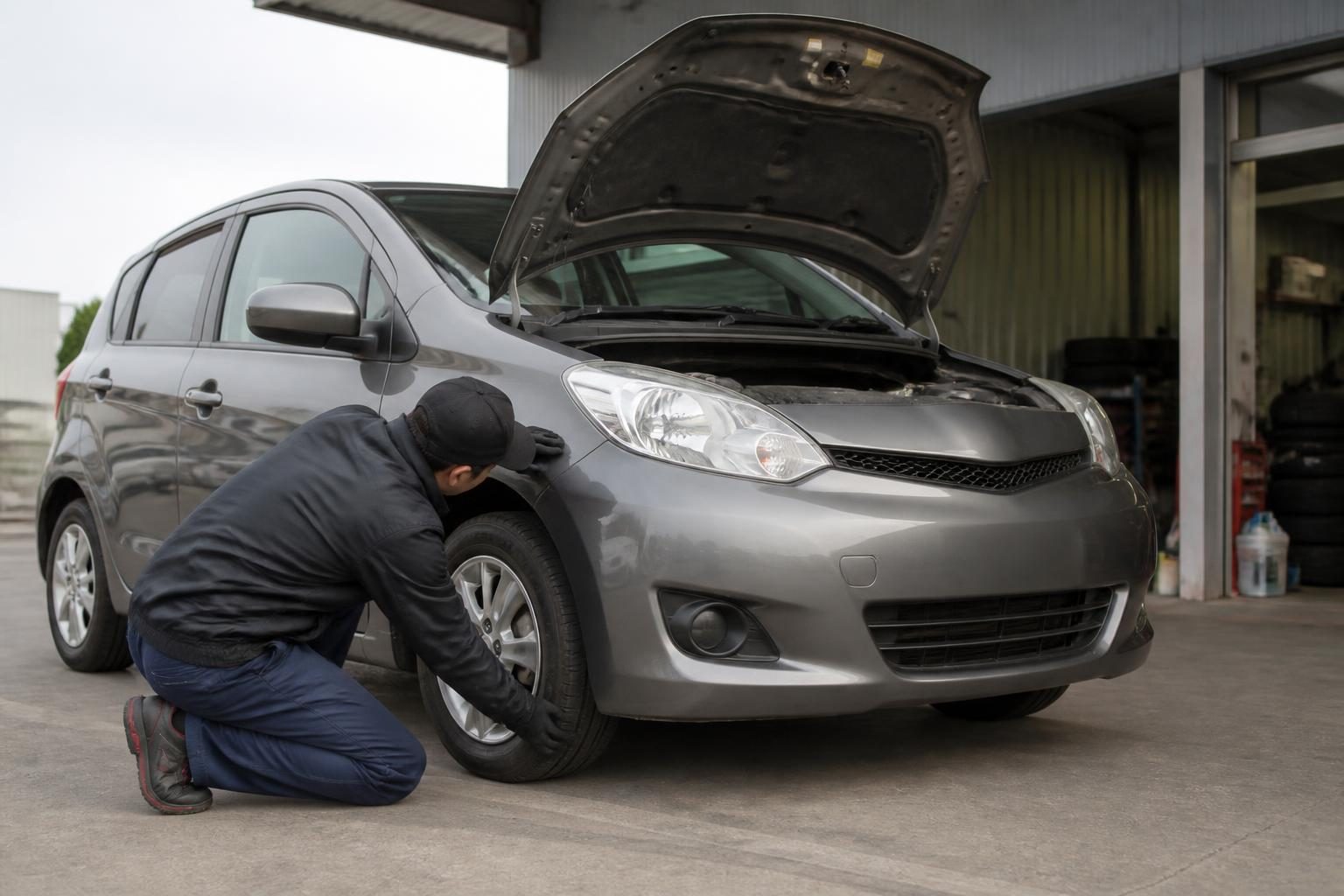 A mechanic checks the front wheel of a hatchback outside a workshop.
Checks before buying or importing a Yaris
Start with the paperwork, then check the exact variant, condition and estimated landed cost. In 2026, the Government of Botswana stated that vehicles three years old and above, calculated from the year of manufacture, must pass a roadworthiness test before registration (Government of Botswana, “Vehicle Registration and Licensing”, 2026).
Use this pre-payment checklist:
- Confirm the model year and exact model.
- Confirm whether it is hybrid or petrol.
- Read the official Japanese auction sheet.
- Check the auction grade and damage symbols.
- Compare the stated mileage with the auction documentation.
- Review the separate inspection report.
- Check tyres, brakes, suspension and underbody condition.
- Confirm air-conditioning operation and warning-light history.
- Review the estimated landed cost for that vehicle.
- Plan for customs clearance, registration and licensing.
BURS says vehicles entering Botswana for home consumption should be cleared through customs within 14 days. Its clearance guidance lists a SAD 500 customs declaration, police clearance from the export country and Botswana, customs documents and an invoice or valuation certificate (BURS, “Clearance of Motor Vehicles”, 2026).
For imports from Japan, the Government of Botswana lists an invoice and bill of lading among the requirements for non-SARPCCO countries. Read Carbarn’s import-rules summary for Botswana, then confirm the current process with BURS and the relevant authorities.
How does the Japan-to-Botswana buying process work?
An import-to-order purchase starts with selecting the exact car and reviewing its documents. Current service guidance indicates about 24 to 34 days from purchase confirmation to arrival, but customs clearance, registration and local collection remain separate buyer responsibilities (How to Buy a Japanese Car, 2026).
The usual sequence is vehicle selection, quote confirmation, payment, inspection, export preparation, RoRo shipping and arrival at Durban or another designated port. From there, the vehicle moves onward through the required Botswana clearance and registration steps.
A vehicle page should show the auction sheet, inspection evidence, model details and an estimated landed-cost panel. Use the 2023 Toyota Yaris hybrid vehicle details to see how those details are presented before making a decision.
Carbarn operates internationally from Japan under Carbarn LLC, and is not a legal entity in Botswana. Its vehicle pages show the official Japanese auction sheet and inspection documentation, with the timing and availability of each report needing confirmation before payment. The published package covers the vehicle, shipping and inspection, while customs duty, VAT, clearance, registration and licensing remain separate costs. Its service includes a per-vehicle landed-cost estimate, dashboard access to invoices, inspection reports, bill-of-lading information and vessel tracking, plus email and WhatsApp support. Vehicles normally travel by RoRo from Japan to Durban, with Walvis Bay as an alternative, then move onward overland. Full payment is required before shipment, current guidance indicates about 24 to 34 days from purchase confirmation to arrival, and responsibility ends there, typically at Durban.
Which Toyota Yaris makes sense for you?
The Yaris is a strong fit if you mostly drive around Gaborone, use paved inter-town roads, carry one to four people and value compact dimensions. The Yaris Cross is worth considering if a higher seating position and more ground clearance matter more than easy parking.
Choose another vehicle if you need substantial boot space, carry several passengers regularly, drive deep sand or poor roads often, or travel fully loaded over long distances. Compare Toyota Yaris vehicles, the Toyota Yaris Cross and the Toyota Yaris model specifications before deciding.