A car with the lowest fuel consumption is not automatically the cheapest car to own. Your answer changes if you commute around Gaborone, travel between towns every week, carry heavy loads or drive only a few thousand kilometres each year.
This guide compares standard petrol, diesel and non-plug-in full hybrids. It focuses on fuel cost, servicing, route suitability, import checks and long-term value. The short answer is simple: hybrid suits stop-start town driving, diesel suits distance and loads, while petrol can suit buyers who value a familiar powertrain and lower annual mileage. The right choice depends on the vehicle and route.
Quick Answer
- Full hybrid: Usually the strongest fit for Gaborone commuting, errands and stop-start traffic.
- Diesel: Worth considering for regular inter-town travel, heavier vehicles and cargo.
- Petrol: May suit shorter trips and lower annual mileage; compare local support for the specific model.
- From 00:01 on 7 July 2026, petrol 95 was P18.21 per litre and diesel 50ppm was P20.93 per litre. Prices change, so recheck them before comparing costs.
- The right fuel type depends on your route, annual distance, vehicle size and maintenance support.
What Does Each Powertrain Do Best in Botswana?
Petrol, diesel and full-hybrid systems solve different driving problems. In 2026, Which? defines a full hybrid as a vehicle that can use electric-only driving at lower speeds, while mild hybrids mainly assist the engine (Which?, “Petrol vs diesel vs hybrid cars: which is better?”, 2026). That difference matters when you compare town use with long-distance driving.
Petrol usually suits smaller cars, shorter journeys and moderate annual mileage. A light petrol hatchback may make more financial sense than a larger vehicle with a more efficient fuel system, depending on purchase price, condition and local support for that model.
Diesel produces strong low-speed torque. That makes it useful for larger vehicles, sustained highway driving, regular passengers, cargo and appropriately rated towing. However, a diesel used mainly for short errands may not deliver enough fuel savings to justify its added system complexity. The break-even point depends on the vehicle and its maintenance needs.
A full hybrid combines a petrol engine, electric motor and battery. It recovers energy while slowing and braking, then uses that energy to assist the engine. It does not need a wall socket. That makes it especially useful for traffic, junctions, school runs and repeated low-speed acceleration.
| Factor |
Petrol |
Diesel |
Full hybrid |
| Strongest use case |
Lower-mileage, simpler ownership |
Distance, loads and larger vehicles |
Town and mixed stop-start driving |
| Fuel-cost potential |
Moderate |
Strong on sustained trips |
Strongest in urban use |
| Main advantage |
Familiarity and a simple powertrain |
Torque and highway efficiency |
Regenerative braking and electric assistance |
| Main caution |
Can use more fuel in larger vehicles |
Repair and parts support vary by model |
Battery condition and diagnostics |
For exact engine size, fuel type and drivetrain differences, compare vehicle specifications by model and variant for the car you are considering.
Which Fuel Type Costs Least to Run in Botswana?
Fuel cost depends on consumption, annual distance and the pump price. From 00:01 on 7 July 2026, Botswana DailyNews reported BERA prices of P18.21 per litre for petrol 95 and P20.93 for diesel 50ppm (Botswana DailyNews, “Fuel prices drop from July 7”, 2026). Diesel was therefore about 14.9% more expensive per litre in that dated example (Botswana DailyNews, “Fuel prices drop from July 7”, 2026).
The useful calculation is:
Annual fuel cost = annual kilometres ÷ km/L × fuel price per litre
A lower consumption figure can offset a higher diesel price. That is why you should compare fuel cost per kilometre, not only the price displayed at the pump.
The table below uses official Japanese WLTC figures and the July 2026 Botswana prices. The vehicles are different sizes, so this is an illustration rather than a direct shopping comparison. The Mazda CX-5 is an SUV, while the Toyota Aqua is a compact hatchback.
| Benchmark |
Official figure |
Approx. cost at 10,000 km |
Approx. cost at 20,000 km |
| Mazda CX-5 2.0 petrol, 2WD |
14.6 km/L WLTC |
About P12,500 |
About P25,000 |
| Mazda CX-5 2.2 diesel, 2WD |
17.4 km/L WLTC |
About P12,000 |
About P24,000 |
| Toyota Aqua, specified 2WD grade/model period |
Up to 34.6 km/L WLTC |
About P5,300 |
About P10,500 |
The petrol and diesel figures come from Mazda’s official CX-5 performance page (Mazda, “CX-5 Performance”, 2026). The Aqua figure comes from Toyota Japan’s Aqua fuel-economy information (Toyota Japan, “Aqua fuel-economy catalogue”, 2024).
For example, the Aqua estimate at 10,000 kilometres uses 10,000 ÷ 34.6, which is about 289 litres. Multiplying that by P18.21 gives approximately P5,300. The result uses Toyota’s specified WLTC figure and the dated petrol price, so actual costs will vary (Toyota Japan, “Aqua fuel-economy catalogue”, 2024; Botswana DailyNews, “Fuel prices drop from July 7”, 2026).
This example shows why diesel can cost less per kilometre than petrol, even when diesel costs more per litre. It also shows why a compact hybrid can use much less fuel. The hybrid, however, is not a size-for-size replacement for a diesel SUV.
Real Botswana consumption will differ. Air-conditioning, speed, traffic, load, tyre pressure, road surface and vehicle condition all affect the result. Use official figures to narrow your shortlist, then compare the actual vehicle’s age, condition and purchase band.
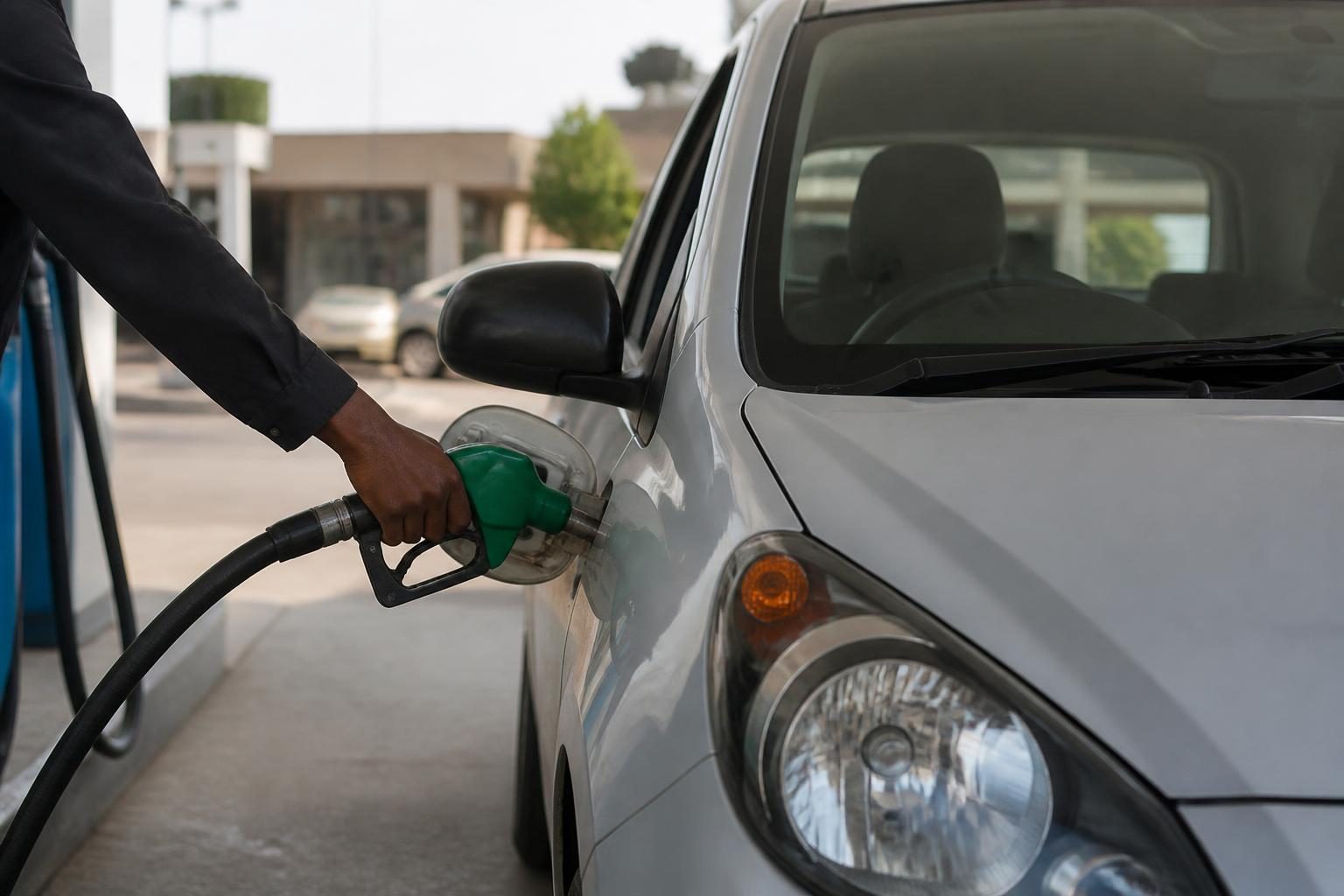 A person refuels a white compact car with a green petrol nozzle at a fuel station.
Is a Full Hybrid the Best Fit for Gaborone Driving?
A full hybrid is probably the strongest starting point for town driving. In 2024, Toyota’s Aqua data listed up to 34.6 km/L WLTC for specified model periods and grades (Toyota Japan, “Aqua fuel-economy catalogue”, 2024). That figure does not apply to every Aqua or hybrid.
Hybrids suit Gaborone commuting, school runs, shopping trips and roads with repeated stops. Regenerative braking captures some energy that would otherwise become heat through the brakes. The electric motor can then assist when the car moves away from a junction.
A full hybrid still uses petrol and needs normal servicing. You must check the engine, cooling system, brakes, tyres, suspension and air-conditioning. You must also assess battery condition, warning lights and hybrid-system diagnostic support.
The main trade-off is purchase cost. An older petrol car may sit in a lower Pula price band, while an efficient hybrid may save more at the pump. Which choice wins depends on annual kilometres and the condition of the specific vehicle.
For model-level reading, compare Toyota Prius hybrid options, Toyota Yaris options and the existing guide to when a hybrid makes sense in Botswana.
A full hybrid is often the strongest urban choice because its motor and regenerative braking work hardest in stop-start conditions. Toyota’s 34.6 km/L WLTC Aqua figure demonstrates the potential, but battery health, age, service records and vehicle size still decide whether a used hybrid represents good value.
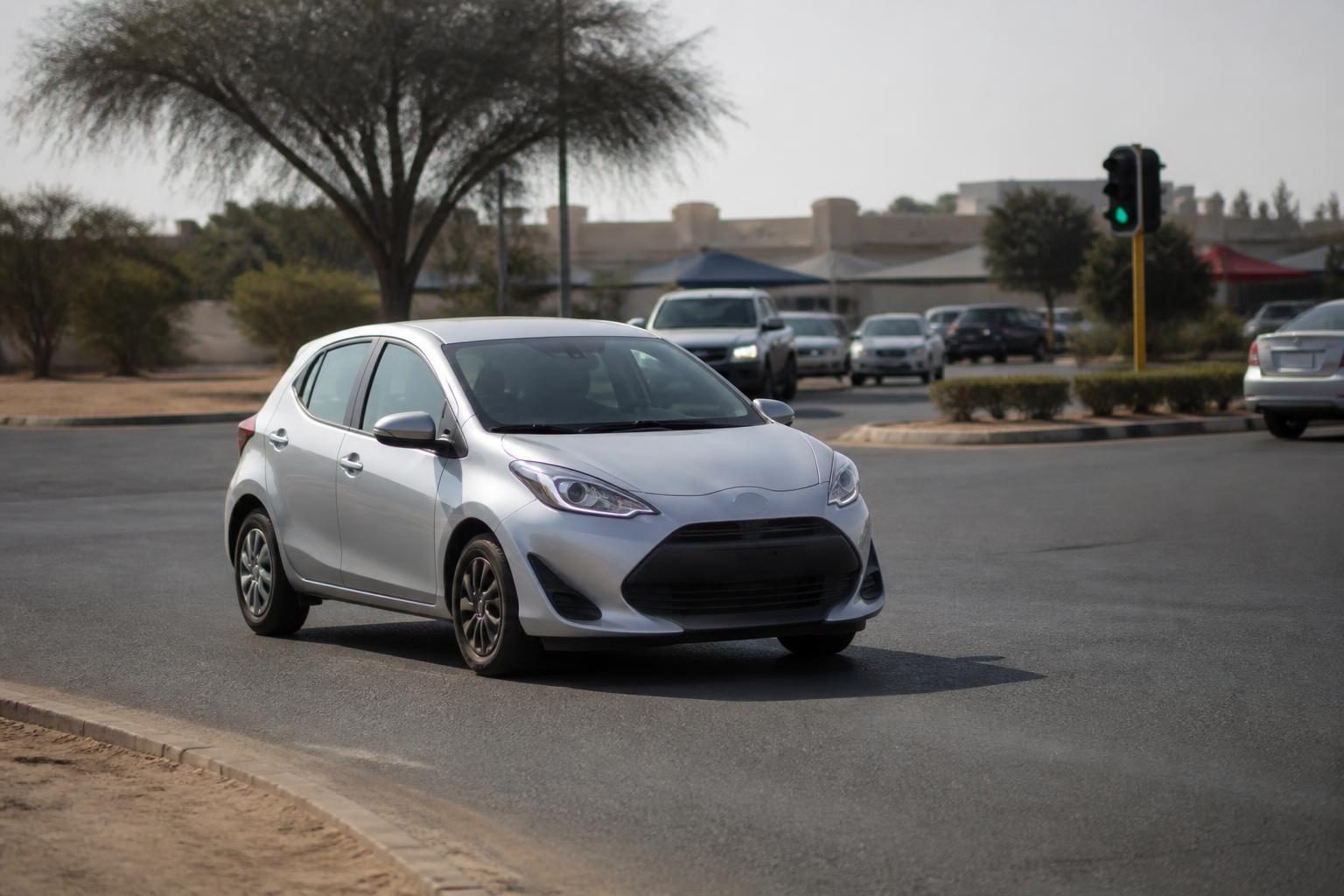 Silver hatchback moves through a quiet suburban junction under natural daylight.
Which Buyers Benefit Most From Diesel?
Diesel makes the most sense when you regularly cover long distances, carry loads or need a larger vehicle. In 2026, Mazda lists 450 Nm of torque and 17.4 km/L WLTC for the 2WD CX-5 SKYACTIV-D 2.2 (Mazda, “CX-5 Performance”, 2026). The figure is a manufacturer test result, not a promise of Botswana consumption.
Diesel suits weekly inter-town travel, rural routes and frequent passenger or cargo use. Strong torque can make a loaded vehicle feel more relaxed on hills and during highway overtaking.
The catch is short-trip use. Mazda explains that repeated journeys of 10 minutes or less, speeds around 15 km/h or below and prolonged idling can prevent normal diesel particulate filter regeneration (Mazda, “Diesel Particulate Filter Information”, 2026).
That guidance applies to the specified Mazda system, not every diesel vehicle. It still shows why service history and usage pattern matter. A diesel hatchback used for short errands may be a poorer fit than a petrol or hybrid equivalent.
Diesel can suit Botswana long-distance buyers because torque and highway efficiency may offset the higher fuel price. The benefit is strongest when the vehicle works hard and travels far. It is weaker when the car spends most of its time idling or making short urban trips.
 SUV with roof luggage on a dusty road in dry bushland under warm light.
When Is Petrol the Sensible Choice?
Petrol remains worth considering when purchase budget, low-to-moderate annual mileage and support for the specific model matter most. In 2026, Suzuki lists 23.4 km/L WLTC for the Swift XG 2WD CVT petrol grade (Suzuki Japan, “Swift Performance and Economy”, 2026). The same page lists 24.5 km/L for specified mild-hybrid grades, so the systems should not be treated as identical.
Petrol suits buyers considering shorter commutes, small hatchbacks and limited annual kilometres. It avoids the need to assess a hybrid traction battery, but service support still depends on the specific model and the provider.
The trade-off is fuel use. A large petrol SUV can cost more to run than an efficient hybrid or diesel vehicle. On long, steady routes, a suitable diesel may also use less fuel per kilometre.
A light petrol car can still be the better financial choice. Buying a larger hybrid or diesel vehicle you do not need may erase its fuel advantage through purchase price, running costs and the condition of the specific vehicle.
Petrol is often the sensible lower-mileage choice when maximum fuel economy is not the only priority. Suzuki’s 23.4 km/L WLTC Swift figure shows that efficient petrol cars can narrow the gap, especially when the vehicle is light and correctly matched to the route.
What Should Botswana Buyers Check Before Importing One?
Fuel type is only one part of value. In 2026, BURS says vehicles entering Botswana for home consumption should be cleared within 14 days. Customs documents, police clearance certificates and an invoice or valuation certificate are among the required paperwork (BURS, “Clearance of Motor Vehicles”, 2026).
Check the following before committing:
- Auction sheet, auction grade and inspection report.
- Odometer consistency and service history.
- Cooling system and air-conditioning performance.
- Tyres, suspension, underbody and ground clearance.
- Parts availability and servicing support.
- Whether the vehicle can be registered under current DRTS requirements.
- Exact fuel type, engine size, drivetrain and model code.
For a hybrid, ask for evidence of battery condition and diagnostic checks. For a diesel, inspect the injectors, turbocharger and emissions equipment. For a petrol car, pay close attention to cooling, oil leaks and general maintenance history.
Botswana’s published import guidance states that there is no general age limit for imported vehicles. That increases choice, including older and cheaper vehicles, but age makes condition and parts checks more important.
The Government of Botswana states that vehicles three years old and above must pass a roadworthiness test for registration (Government of Botswana, “Vehicle Registration and Licensing”, 2026). Customs clearance, registration and annual licensing remain separate from the vehicle price.
Customs duty is tariff-dependent rather than a universal 27% rate. BURS applies the tariff rate for the vehicle and import circumstances, while VAT and charges such as clearance, registration and licensing are calculated separately. Do not assume a quoted vehicle price includes any of them.
For the process, review Botswana import rules and documents and how the Japan-to-Botswana buying process works.
The most expensive mistake is choosing a fuel type before checking the vehicle’s condition. A well-documented petrol car may beat a neglected hybrid, while a carefully inspected diesel may suit a distance driver better than either.
How Can You Compare Japan-Sourced Cars for Botswana?
Japan-sourced vehicles may be quoted with different timing estimates because the stages are not always measured from the same starting point. The current terms state 6 to 8 weeks from confirmation of full payment. Some vehicle pages quote about 40 days to Durban, while other published guidance states about 24 to 34 days from purchase confirmation to arrival.
Treat the current terms and the vehicle’s proforma invoice as the controlling documents. Ask whether an estimate covers payment to arrival in Botswana or only shipment to the export port. The buying guide describes two reports before payment, including the Japanese auction sheet and an in-house inspection report (Carbarn, “How to Buy a Japanese Car from Carbarn Botswana”, 2026).
Carbarn Botswana operates internationally from Japan under Carbarn LLC. It is not a legal entity, branch or showroom in Botswana. Buyers can compare petrol, diesel and hybrid cars for Botswana using fuel-type, make, model, engine-size and body-style filters.
The quoted vehicle price covers the vehicle, shipping and inspection. Customs duty, VAT, clearance, registration and licensing remain separate buyer responsibilities. Review the individual vehicle page’s Estimated landed cost in Botswana panel rather than relying on a generic calculation.
Shipping is typically by RoRo to Durban, with Walvis Bay as an alternative. The route may then continue overland into Botswana. Responsibility ends at the designated export port, typically Durban.
Which Powertrain Should You Choose for Botswana?
The Government of Botswana requires annual vehicle licence renewal, while vehicles three years old and above need a roadworthiness test for registration (Government of Botswana, “Vehicle Registration and Licensing”, 2026). That is a useful reminder that fuel economy is only one part of ownership cost.
| If you mainly… |
Best starting point |
Why |
| Drive around Gaborone and in traffic |
Full hybrid |
Strong stop-start fuel-saving potential |
| Travel between towns every week |
Diesel or efficient petrol |
Suits sustained road use |
| Carry regular loads |
Diesel |
Strong torque and larger-vehicle availability |
| Drive limited kilometres |
Petrol |
Avoid paying for efficiency you may not use |
| Want low fuel use in a compact car |
Full hybrid |
Strong urban efficiency potential |
| Want familiar servicing |
Compare model support |
Parts and diagnostic access vary by vehicle |
Full hybrid is the strongest starting point for urban and mixed stop-start driving. Toyota’s Aqua figure of up to 34.6 km/L WLTC shows the potential in a specified compact model, although battery health, age, service records and vehicle size still matter (Toyota Japan, “Aqua fuel-economy catalogue”, 2024).
Diesel is the better match for regular distance, heavier loads and larger vehicles. Its advantage depends on sustained use, because repeated short trips can create particulate-filter concerns in some systems (Mazda, “Diesel Particulate Filter Information”, 2026).
Petrol remains worth considering for lighter use and lower annual mileage. Suzuki’s Swift XG 2WD CVT petrol grade is listed at 23.4 km/L WLTC, showing that a light petrol car can still be economical when matched to the route (Suzuki Japan, “Swift Performance and Economy”, 2026).
The poor choice is not one particular fuel type. It is choosing a powertrain that does not match your route, annual distance, vehicle size or maintenance support.