A hybrid Corolla may reduce fuel spending, but whether importing one costs more upfront depends on the exact car, shipping route and petrol alternative. The real question is whether your daily driving will justify the total cost.
“Toyota Corolla Hybrid” can mean several Japanese-market vehicles, not one car. This guide separates the modern Corolla sedan and hatchback from the older Corolla Axio and Corolla Fielder, then compares the smaller Toyota Aqua as an alternative. They differ in size, age, space and model code. We explain the fuel figures, condition checks, Botswana road fit and import costs before you choose.
Quick Answer
- A Corolla Hybrid suits town driving, family use and regular tar-road travel.
- In 2022, Toyota rated one Corolla Hybrid X at 30.2 km/L under WLTC, although actual results vary with speed, load, air-conditioning and tyres (Toyota Japan Corolla Hybrid X specification, 2022).
- Check the exact model code, auction sheet, inspection report, warning lights and hybrid-system condition.
- The vehicle price is not automatically the final landed or registered cost.
Toyota Corolla Hybrid Fit for Botswana
In 2022, Toyota Japan listed the Corolla Hybrid X with a 1,797cc engine, five seats, front-wheel drive and an electric continuously variable transmission (Toyota Japan Corolla Hybrid X specification, 2022). That makes it a strong fit for urban commuting and sealed-road family travel, rather than deep sand or rough tracks.
Many drivers may find the modern Corolla sedan easy to place around Gaborone. Its hybrid system is designed to use electric assistance during some launches and braking, which can suit stop-start traffic. It can also suit drivers who regularly travel between towns on paved roads.
The compromises are straightforward. This is a front-wheel-drive sedan, so buyers should not treat it as a serious off-road vehicle. Deep sand, rough tracks and heavily rutted roads may call for more clearance and different tyres. A fully loaded car may also feel less comfortable on poor surfaces.
Botswana has no general import age restriction, which creates more choice, but that does not make an older vehicle ready for registration. A vehicle three years old or older, measured from its year of manufacture, must pass a roadworthiness test before registration. Older hybrids also need closer checks of battery condition, parts access, service evidence and likely resale demand.
Toyota Corolla cars available in Botswana
For more options, compare Toyota vehicles sourced from Japan, including smaller hatchbacks and higher-clearance models.
How Much Fuel Does a Toyota Corolla Hybrid Use?
In 2022, Toyota Japan rated the Corolla Hybrid X at 30.2 km/L under WLTC, with figures of 28.6 km/L in urban driving, 34.0 km/L in suburban driving and 28.8 km/L on the highway (Toyota Japan Corolla Hybrid X specification, 2022). These are test results, not promised Botswana consumption.
| Driving measure |
Official figure |
Test cycle |
| Combined |
30.2 km/L |
WLTC |
| Urban |
28.6 km/L |
WLTC |
| Suburban |
34.0 km/L |
WLTC |
| Highway |
28.8 km/L |
WLTC |
WLTC combines urban, suburban and highway conditions. JC08 is an older Japanese test standard. Toyota’s Corolla fuel catalogue lists the 2019-on range at 14.6–30.2 km/L under WLTC and 28.4–35.0 km/L under JC08, depending on the variant (Toyota Japan Corolla fuel-economy catalogue, 2026).
That difference matters when comparing models. Air-conditioning, higher cruising speeds, passengers, luggage, tyre pressure and gravel roads can all reduce actual economy. A driver spending most days in Gaborone traffic may see a different result from someone travelling quickly between towns.
Why older hybrids can look better on paper
In 2019, Toyota listed the Corolla Axio Hybrid EX and Corolla Fielder Hybrid EX at 34.4 km/L under JC08 (Toyota Japan Corolla Axio Hybrid EX specification, 2019; Toyota Japan Corolla Fielder Hybrid EX specification, 2019). That higher figure does not prove either car will use less fuel in every Botswana journey.
Official fuel figures are useful for comparing similar vehicles tested under the same standard. They become misleading when a 34.4 km/L JC08 figure is placed beside a 30.2 km/L WLTC figure without explanation. The test cycle is part of the specification.
What Should You Check Before Importing a Used Corolla Hybrid?
In 2024, Toyota’s improvement notice covered some Corolla hybrids built between 2022 and 2024 because brake-actuator software could affect hydraulic pressure during certain braking situations (Toyota Japan hybrid Corolla improvement notice, 2024). Check the exact chassis number, rather than relying on the model year alone.
A proper pre-payment review should cover:
- The official Japanese auction sheet.
- Auction grade and repair-history markings.
- Odometer consistency across documents and photos.
- Warning lights during ignition.
- Engine start-up and idle behaviour.
- Brake feel and suspension condition.
- The 12-volt battery.
- Hybrid battery cooling fan and ventilation area.
- Service records, where available.
- Accident repairs, corrosion and poor previous repairs.
A hybrid battery is a possible future repair cost. That does not make every older hybrid a poor purchase. It means the vehicle’s condition, history and inspection evidence should influence the price you are willing to pay.
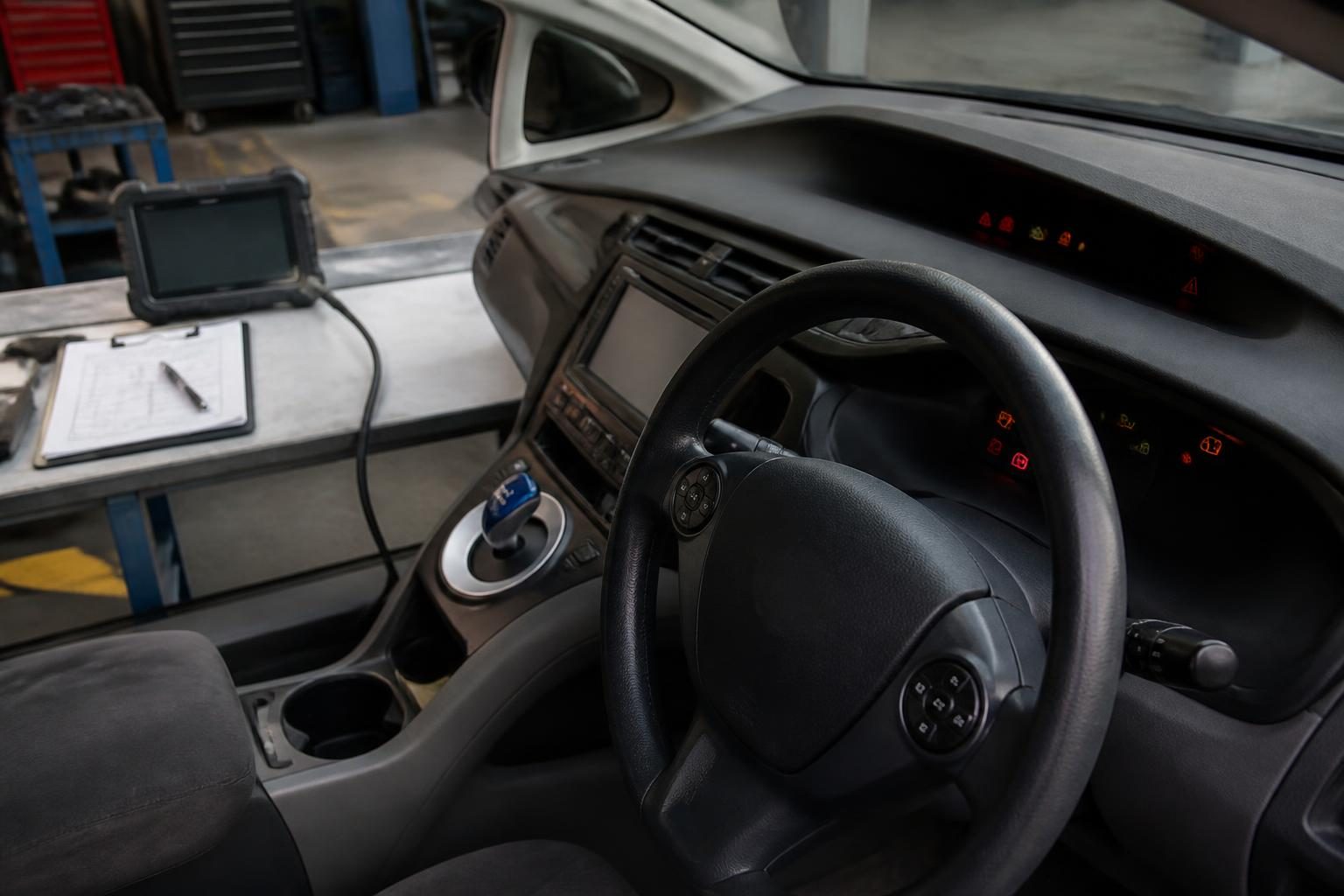 Hybrid-style dashboard inspection with warning indicators and diagnostic equipment.
What can the reports tell you?
The auction sheet records the Japanese auction assessment and visible condition. A separate in-house inspection report can add another view of the body, tyres, underbody, interior and noted defects. Neither document replaces checking the exact model code and final costs.
Auction grades are high-level assessments, so a grade 4 should not be treated as a guarantee of cosmetic condition or battery health. Ask which checks were completed, whether warning lights appeared and whether the report identifies details beneath the broad auction grade.
Which Japanese Corolla Body Style Suits You?
In 2019, Toyota listed the Axio Hybrid as a 1.5-litre, five-seat sedan producing 74ps and 111Nm, while the Fielder used the same engine family in a five-door wagon (Toyota Japan Corolla Axio Hybrid EX specification, 2019; Toyota Japan Corolla Fielder Hybrid EX specification, 2019). The newer Corolla sedan uses a 1.8-litre hybrid system, so these are related choices, not identical cars.
| Vehicle |
Best for |
Main strength |
Main compromise |
| Corolla Hybrid sedan |
Buyers wanting a newer five-seat sedan |
Modern body and strong WLTC economy |
Different cost and road-use trade-offs |
| 2018 Corolla Hybrid hatchback |
Buyers wanting a compact hatch |
Shorter body and easy urban size |
Different vehicle from the sedan |
| Corolla Axio Hybrid |
Buyers prioritising value and a compact sedan |
Simple sedan format |
Older design and different dimensions |
| Corolla Fielder Hybrid |
Families needing luggage flexibility |
Practical five-door wagon |
Older examples may have more wear |
| Toyota Aqua |
City-focused buyers seeking a smaller hybrid |
Small size for urban driving |
Compare its space and fuel figures by variant |
2018 Toyota Corolla Hybrid hatchback: what the record shows
The 2018 Toyota Corolla Hybrid hatchback example is identified as a hybrid with model code ZWE211H, five seats, 94,000 kilometres and auction grade 4.
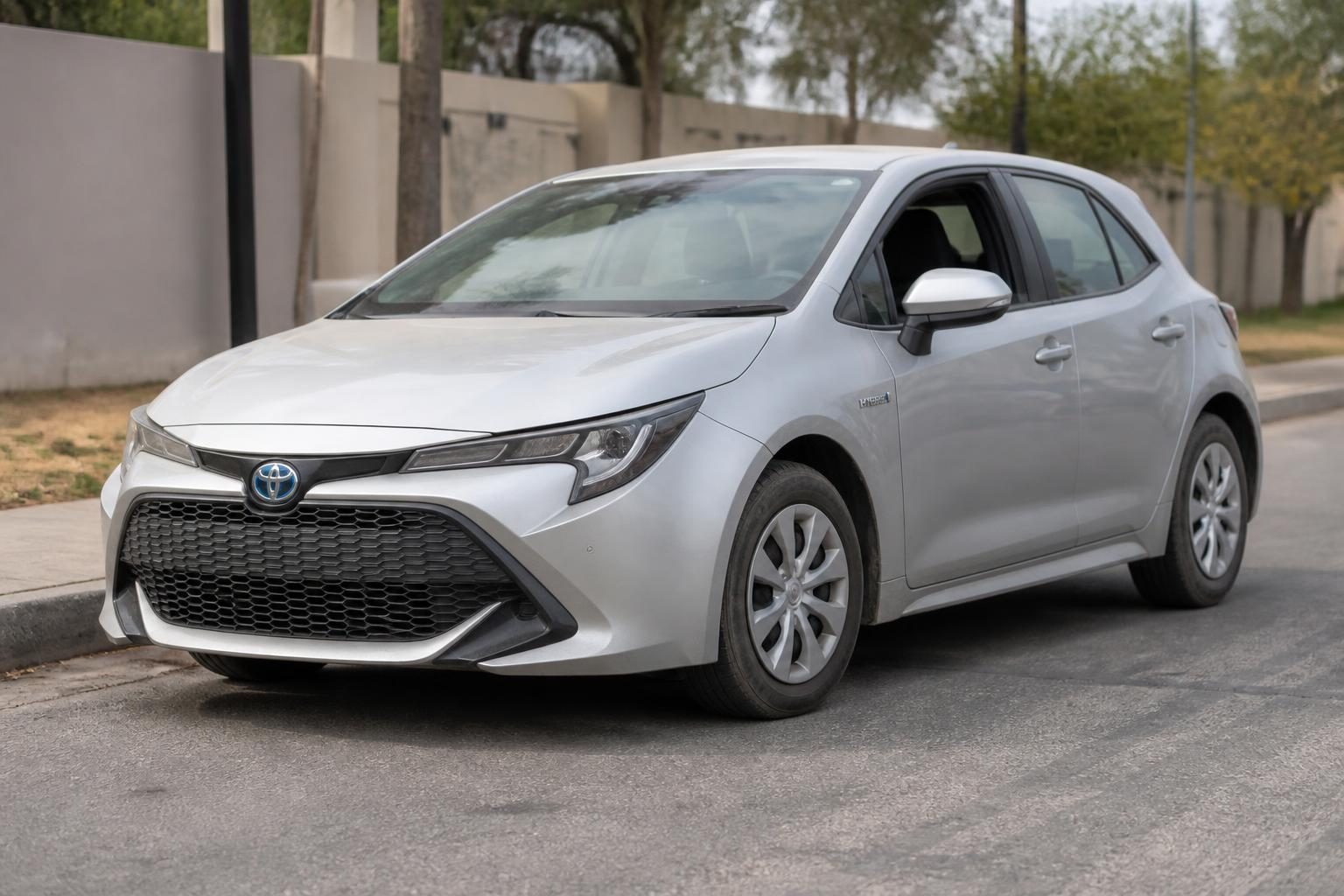 2018 Toyota Corolla
This record matters because it is a hatchback, not the modern Corolla sedan. The page lists power as 98, but does not show the unit. Confirm the output, torque, fuel-tank size and official test-cycle economy from the full vehicle documentation rather than copying figures from a different Corolla variant.
Choose the modern sedan if cabin refinement matters most. Choose the Axio when compact dimensions and purchase value lead the decision. Choose the Fielder when luggage space matters. A Toyota Aqua for buyers who want a smaller hybrid may suit mostly urban driving better.
The word “Corolla” does not tell you enough. Model code, body style, age, odometer and auction grade give a much clearer picture of what you are considering.
Costs Outside the Vehicle Price
In 2026, BURS states that vehicles entering Botswana for home consumption should be cleared within 14 days of entry and require documents including SAD 500, police clearances, export customs documents and an invoice or valuation certificate (BURS Clearance of Motor Vehicles, 2026). Registration may also involve physical inspection and a BP17B police clearance form, so import planning needs more than a vehicle price.
Budget in separate layers:
- Vehicle cost.
- Shipping and inspection.
- Customs duty and applicable taxes.
- Clearance or clearing-agent charges.
- Registration and licensing.
- Local movement after port release.
CIF usually refers to cost, insurance and freight, but the final customs assessment can also depend on classification and valuation rules. Confirm treatment with BURS and the current tariff information. Do not treat an advertised vehicle-plus-shipping figure as the landed or registered-on-road total.
Shopping prices vary with the model year, auction grade, odometer, body style and exchange-rate movement. Compare the individual vehicle-plus-shipping figure with similar cars, rather than treating an unsupported price band as a market-wide valuation.
Use the individual vehicle page’s Estimated landed cost in Botswana panel only as a seller estimate, not as an official BURS calculation. Confirm the final figures in the proforma invoice and with BURS. Customs duty, applicable taxes, clearance, registration and licensing remain separate costs unless the current documents state otherwise.
How Do You Choose and Import the Right Corolla Hybrid?
In 2026, the BURS customs tariff download page lists April 2026 tariff volumes, showing why current import treatment should be checked before payment (BURS Customs Tariff Downloads, 2026). A careful purchase starts with vehicle identity, then moves through reports, costs and clearance planning.
Use this checklist:
- Decide between sedan, hatchback, Axio, Fielder and Aqua.
- Set a BWP budget band with room for clearance and registration.
- Confirm the exact model code and fuel type.
- Read the Japanese auction sheet.
- Review the inspection report.
- Check odometer, grade, repairs and warning lights.
- Confirm what the quoted price includes.
- Review the vehicle-specific landed-cost estimate.
- Confirm shipping documents and responsibilities.
- Plan for BURS clearance and local servicing.
The route is:
Japan → RoRo shipping to Durban, South Africa → overland movement into Botswana
Shipping times are estimates, and Carbarn pages currently quote different timeframes, including approximately 40 days and about 24 to 34 days. Confirm the current schedule in the final quote and shipping documents.
Buyer-fit summary
The Corolla Hybrid is probably the best fit if you:
- Drive regularly in town and on tar roads.
- Want lower fuel use without moving to a full electric vehicle.
- Need a comfortable five-seat car.
- Can budget for import, clearance and future hybrid diagnostics.
Choose another model if you:
- Need high clearance or serious off-road ability.
- Need wagon luggage space.
- Want the lowest possible upfront cost.
- Drive mainly at high inter-town speeds.
What Support Should You Expect When Importing From Japan?
A transparent import service should provide vehicle evidence before payment, explain what the quoted price covers and show where responsibility ends. Buyers should also receive clear shipping documents and a way to track the export process.
The service should not be confused with a local showroom or a Botswana dealership. The vehicle remains in Japan until export, and the buyer remains responsible for Botswana clearance, registration and licensing obligations.
Toyota Corolla cars available in Botswana
how to buy a Japanese car in Botswana
Botswana vehicle import rules and documents
The Carbarn service identifies its operator as Carbarn LLC in Japan. Its vehicle pages show a Japanese auction sheet and an in-house inspection report, while the stated route is normally RoRo to Durban, with Walvis Bay as an alternative port. Before paying, confirm ownership, the documents supplied, payment timing, warranty and financing terms, and the point where responsibility ends in the current terms and vehicle-specific quote.
A Japanese Corolla Hybrid can suit Botswana well when your driving is mostly urban and on sealed roads. The sensible choice depends on the exact body style, model code, test cycle and condition evidence.
Official figures such as 30.2 km/L WLTC are useful, but they are not a promise of local fuel consumption. Compare the full import budget, not just the vehicle price, before choosing your preferred Toyota Corolla vehicles for Botswana.