Look around Gaborone on any working morning and the Hiace is doing most of the heavy lifting. It carries building materials to Tlokweng, stock to a shop in Mogoditshane, church groups up the A1 to Francistown, and tools to a job in Lobatse. It is the van the country runs on, which is exactly why buying a bad one hurts so much.
Most buyers end up choosing between two routes. One is a local yard where the van is in front of you but its history is mostly a story. The other is a direct import from Japan, where you can't touch the van before you pay, but its whole life is written down: an auction sheet, an odometer reading, a condition report with photographs.
Two engine families dominate the Hiace vans coming into Botswana right now. The 2.8 litre 1GD-FTV turbo diesel and the 2.0 litre 1TR-FE petrol. They are built differently, they wear differently, and they need different questions asked of them.
This guide covers how to read the auction grade, what to inspect by engine and by mileage, which real listed vans illustrate each case, and which one is likely to suit your kind of work.
At a Glance
- Japan supplied 85.2% of Botswana's used vehicle imports in Q4 2025, with used vehicles making up 79.6% of all first-time registrations (IndexBox / Statistics Botswana)
- Two engine families to choose between: the 1GD-FTV 2.8 diesel (151 PS) and the 1TR-FE 2.0 petrol (136 PS). They fail differently, so they inspect differently
- Grade 4 is a sensible floor on a petrol van. Grade 3.5 is fine on a diesel if the mileage is proportionate and the turbo checks out
- The auction grade describes cosmetic condition, not mechanical history. You want the auction sheet and the inspection report side by side
- 169,000 km is not automatically a bad buy on a well-kept 1GD-FTV, but it earns a turbo smoke check, a cold-start listen and an underbody inspection
Why the Hiace Is the Van Botswana Keeps Buying
Toyota was the third most registered brand in Botswana in Q4 2025 at 16.9% of registrations (IndexBox / Statistics Botswana), and the Hiace is a large part of why. Parts move, mechanics know it, and resale stays strong because the next buyer wants the same thing you did.
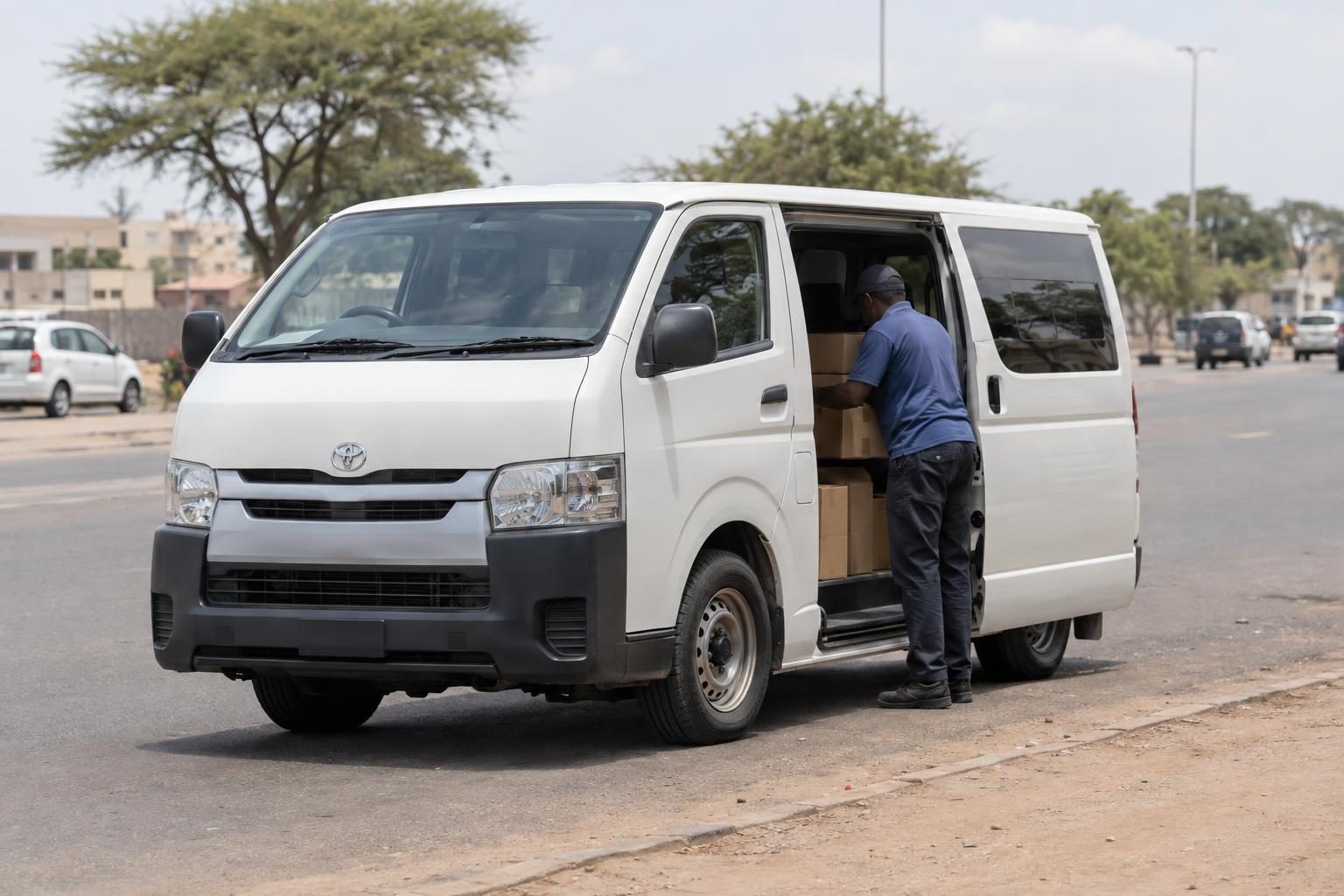 A Toyota Hiace van is loaded with boxes at the roadside.
The practical case is simple. A one-tonne-class van with a flat floor and a sliding door does more real work than a double-cab bakkie for the same money, and it does it with the load out of the sun and the dust. On a long tar run like the A1 or the A3 up to Kasane, the diesel version sips fuel in a way that a petrol SUV of similar size cannot match.
There's also a Botswana-specific advantage worth knowing. Botswana does not apply an import age limit, so you can legally consider older and cheaper stock that buyers in several other African and Asian markets are simply blocked from. The trade-off is that nobody is protecting you from a worn-out van, so the inspection work falls to you. The import rules and regulations page sets out the eligibility side, including the right-hand-drive requirement.
One safety note before you shortlist. Independent testing in New Zealand records the pre-2019 Hiace at a 4-star ANCAP rating, with 2019-onward models reaching 5 stars with electronic stability control as standard (MyAutoShop). If the van will carry passengers regularly, that year boundary matters more than a half-point of auction grade.
Diesel or Petrol: Which Hiace Engine Fits Your Work?
Pick the engine before you pick the van. The 1GD-FTV diesel is rated at 151 PS in Hiace form and is documented as reaching 300,000 km routinely, with well-maintained examples exceeding 400,000 km (MotorReviewer). The 1TR-FE petrol makes 136 PS and has far fewer parts that can go expensively wrong.
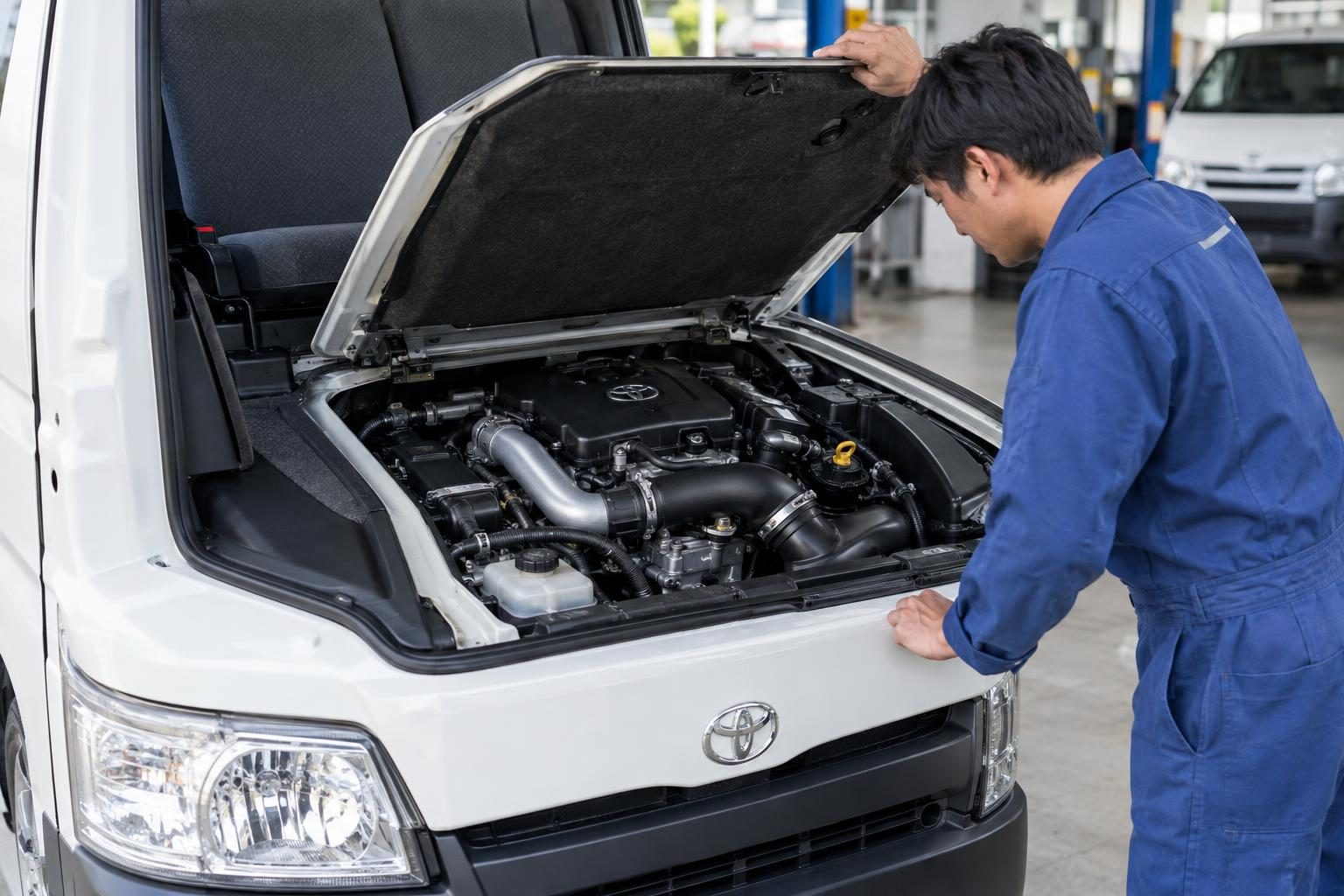 A mechanic inspects the engine through the Hiace's cab-floor hatch.
| Factor |
1GD-FTV 2.8 turbo diesel |
1TR-FE 2.0 petrol |
| Listed output |
151 PS |
136 PS |
| Configuration |
Inline 4, intercooled turbo |
Inline 4, naturally aspirated |
| Timing drive |
Chain |
Chain |
| Fuel use |
Around 8.0–8.1 L/100 km on a highway run (approximate; official JP-market WLTC combined figure for the GDH201V) |
Noticeably higher than the diesel in mixed use |
| Expected life |
300,000 km typical, 400,000 km-plus when maintained (MotorReviewer) |
Long-lived, but lower torque under load |
| Main wear items |
Turbo, EGR carbon, DPF, common-rail injectors |
Few. Ordinary service items |
| Fuel quality sensitivity |
High. Common-rail diesel dislikes dirty fuel |
Low |
| Best suited to |
Loaded inter-town running, long daily distances |
City and peri-urban work, lighter loads |
The 1GD-FTV 2.8 Turbo Diesel
This is the engine in the GDH201V and GDH206V vans. It replaced the older 1KD-FTV and brought a timing chain instead of a belt, which removes one scheduled big-ticket job from the ownership plan. It is also the reason a Hiace can do Gaborone to Francistown twice a week for years without complaint.
The known weak points are worth memorising. Early 1GD production suffered timing chain rattle from an incorrectly angled oil nozzle, usually appearing around 30,000 to 50,000 km, and later engines got revised tubing (MotorReviewer). Add EGR carbon build-up on short-haul vans, turbo seal wear at higher mileage, and Denso common-rail injectors that do not forgive poor-quality diesel. Injector replacement is commonly planned for around the 200,000 km mark (ReDriven).
The 1TR-FE 2.0 Petrol
The petrol van is the quieter choice in every sense. No DPF, no EGR headaches, no injector pump that panics about fuel quality. For a buyer in Gaborone doing short runs with light loads, that simplicity is genuinely valuable, because the cheapest repair is the one you never have to book.
The cost is fuel and pulling power. Loaded and climbing, the 2.0 petrol works much harder than the 2.8 diesel, and you'll feel it in the tank on long trips. Note also that the petrol vans listed here are high-roof bodies at 2,240 to 2,245 mm tall with 18 m³ of listed load space, while the diesels are the 1,980 mm standard-roof body at 16 m³. Measure your garage and your usual load before you decide.
Do You Actually Need the 4WD?
Most Botswana Hiace buyers do not. The rear-wheel-drive van handles tar, gravel district roads in the dry, and a sand driveway fine. The 4WD version earns its extra cost and extra inspection points only if your week genuinely includes bad surfaces.
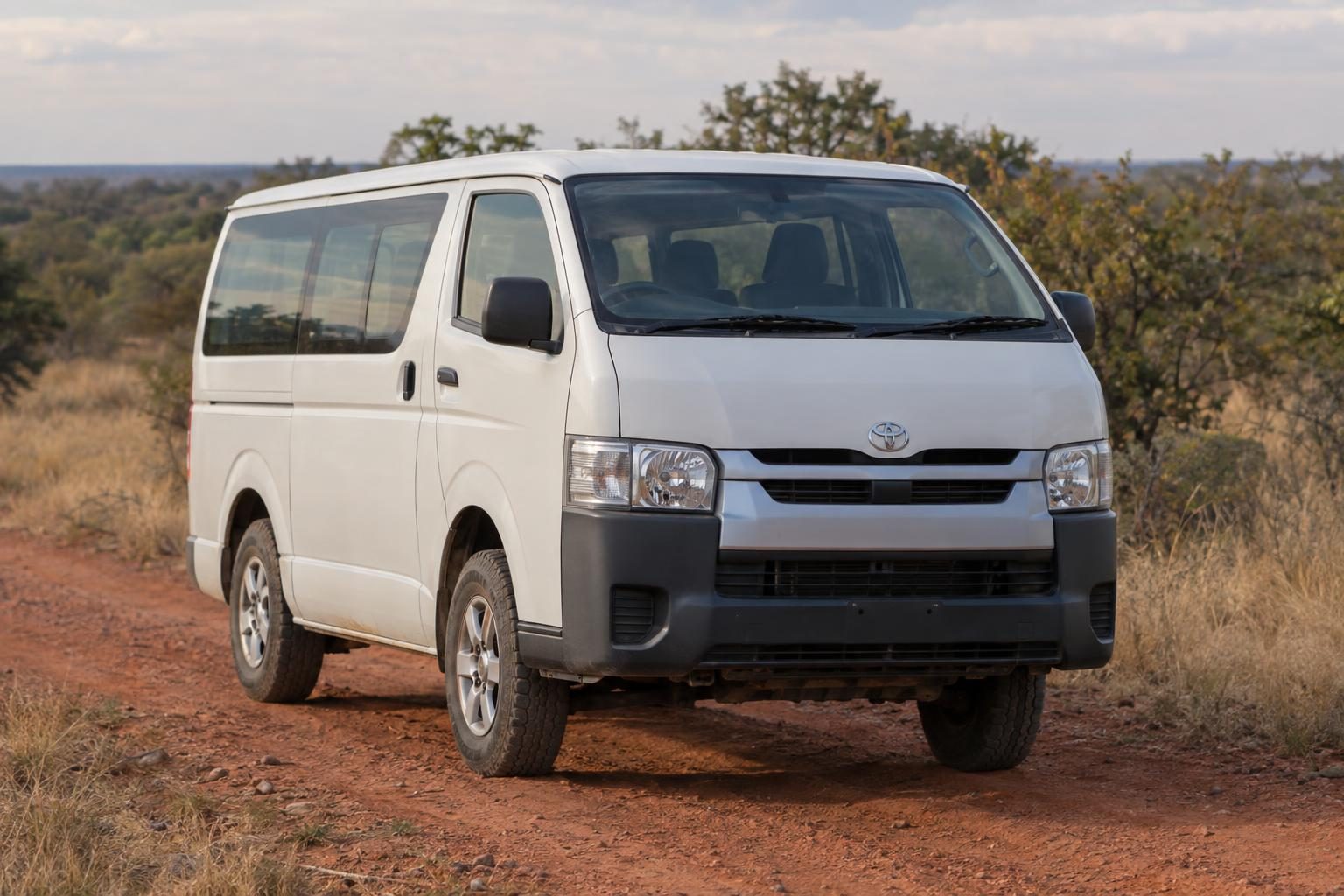 Toyota Hiace H200 on a red dirt track in dry scrubland.
Rear-wheel drive suits urban and peri-urban business delivery, tarred inter-town routes, and school or staff transport. The 4WD version makes sense for farm access, lodge roads around Maun and Kasane, wet-season crossings, and the kind of soft sand where a loaded rear-drive van digs in rather than climbs out.
The 4WD van also adds real inspection work. You need to engage the system during inspection and confirm it locks in and releases cleanly with no grinding. You need to look at the transfer case for leaks around the front output seal, check the front CV boots for cracked or split rubber, and ask whether the differential oil has been serviced. Hiace differential oil is generally recommended at 40,000 km intervals (ReDriven), and on a high-mileage import you want to know the answer rather than assume it.
If your routes are entirely tarred, the rear-drive diesel is simply the more sensible buy. You get the same engine, one less drivetrain to maintain, and the money stays in your pocket for tyres and a service.
What Does the Auction Grade Really Tell You?
A Japanese auction grade is a cosmetic and overall condition score assigned by an independent appraiser at the auction house, not a mechanical roadworthy certificate. Grade 3.5 is the most common grade on sound older stock, while grade 4 is less common and signals a genuinely well-kept example (everycar.jp).
| Grade |
What it usually means |
Sensible approach for a Botswana buyer |
| 5 and above |
Excellent, very low mileage |
Buy with confidence if the price fits |
| 4.5 |
Very good, light surface wear only |
Strong choice. Near the top of the range |
| 4 |
Above average. Minor cosmetic marks, nothing structural |
A good floor for a petrol van |
| 3.5 |
Average. Scratches, dents, interior wear |
Fine on a diesel if mileage and mechanicals support it |
| 3 |
Heavier cosmetic wear, possible rust marks |
Buyable, but inspect properly and expect a lower price |
| R or RA |
Repaired structural damage |
Walk away |
Here is the part most first-time importers miss. The grade is a starting point, not a verdict. A grade 3.5 van at 88,000 km with clean service history and a healthy turbo is a better purchase than a grade 4 van with no service stamps at all. Cosmetics are cheap to fix. A tired common-rail diesel is not.
Read the sheet for where the marks sit, not just how many there are. Marks on panels are normal wear. Marks noted near frame rails, sills or the underbody deserve a second opinion before you commit. The buying guide walks through what documentation accompanies a vehicle and at which step it reaches you.
The Petrol Hiaces: Low Mileage, Simple Mechanicals
These three 1TR-FE vans are the lowest-risk end of the Hiace market in Botswana. All are automatic, rear-wheel drive, high-roof bodies with 18 m³ of listed load space, and all carry grades of 4 or better. The inspection list is shorter, but it isn't empty, and tyre age is the item people forget most often.
2022 Toyota Hiace Van Long DX, Grade 4.5 at 7,000 km
The 2022 Toyota Hiace petrol is the benchmark for what clean looks like in this range. At 7,000 km with an auction grade of 4.5 and a Carbarn inspection recording no damage found on exterior or interior, it is about as close to an unused commercial van as the import market offers. If you want a reference point for judging every other Hiace you look at, this is it.
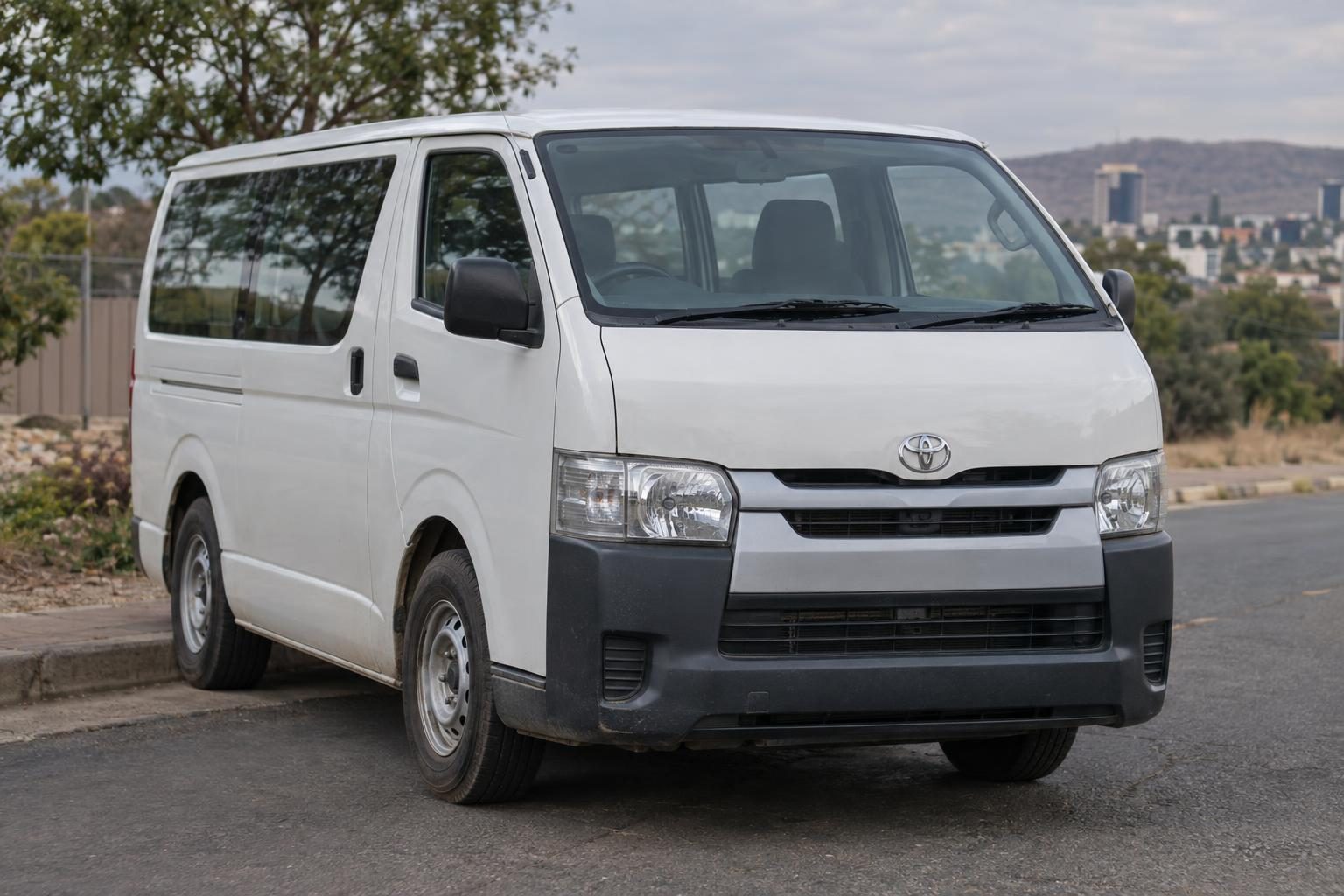 2022 Toyota Hiace — Petrol (TRH200K)
On specification it is a TRH200K: 1TR-FE inline four, 2,000 cc, 136 PS, six-speed automatic, rear-wheel drive, finished in black. The body measures 4,695 mm long, 1,695 mm wide and 2,245 mm tall on a 2,570 mm wheelbase, with three seats and the cargo bay behind them. Equipment runs to air conditioning, airbags, power windows, UV filter glass, adjustable steering, ABS, traction control, electronic brake-force distribution and brake assist.
What should you still check on something this fresh? Tyre manufacture date first. Rubber ages on the calendar, not the odometer, and a van that covered 7,000 km over several years may be riding on tyres approaching the end of their safe life. Then confirm whether the first scheduled service was actually carried out, look at the cargo floor and tie-down rails for load scuffing, and check the rear door seals. This one suits a buyer who wants near-new condition without a new-vehicle invoice, and it sits toward the upper end of the Hiace price range as a result.
2021 Toyota Hiace Van DX, Grade 4 at 13,000 km
The 2021 Toyota Hiace petrol is the passenger-configured option in the petrol group, with six seats instead of three. At 13,000 km it has barely been used, and a grade 4 with no damage found in the Carbarn inspection backs that up. For a business moving staff, or a family that needs real seat count without stepping up to a minibus, this is a sensible shape of van.
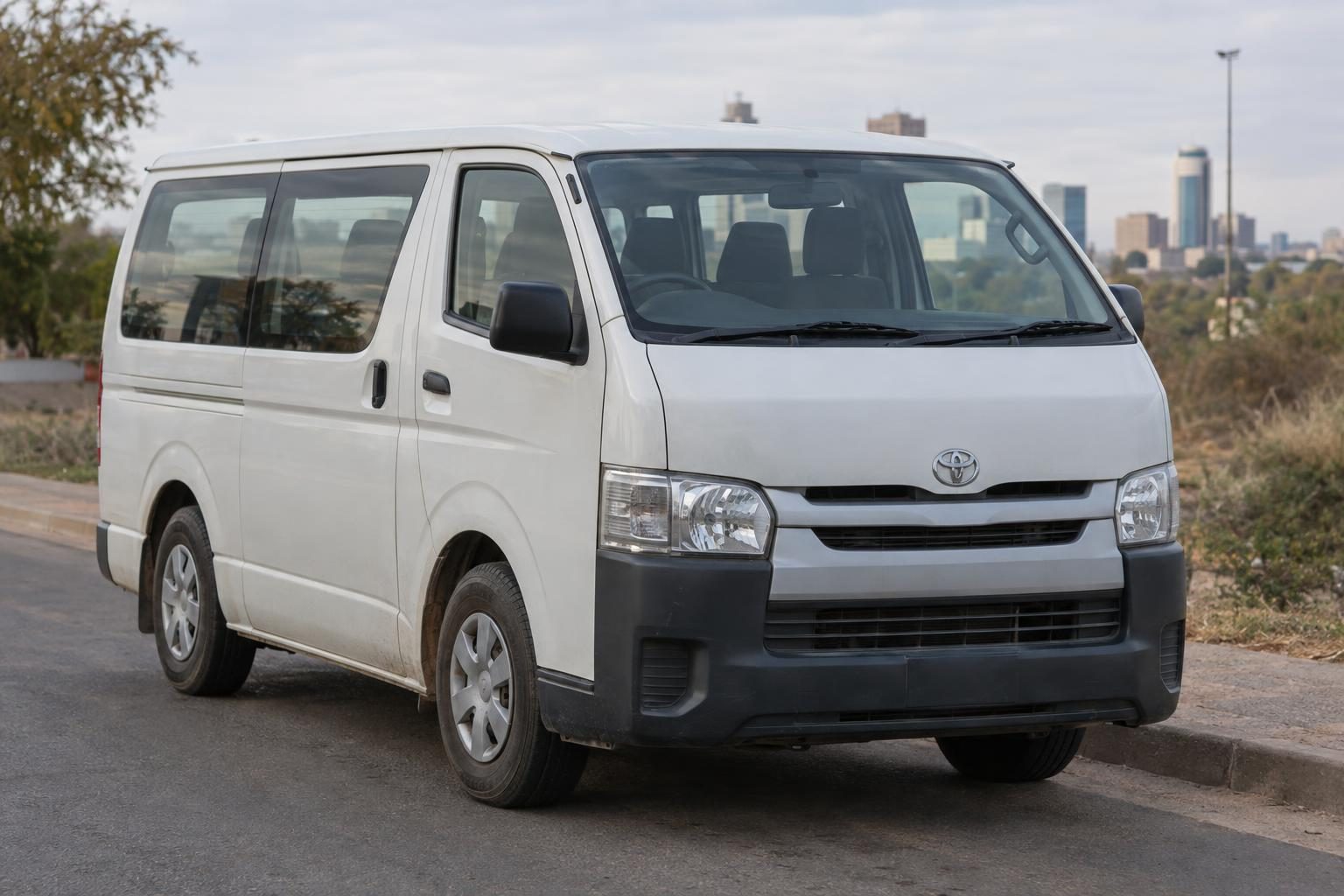 2021 Toyota Hiace — Petrol (TRH200K)
Mechanically it matches its stablemates: TRH200K chassis, 1TR-FE 2,000 cc inline four, 136 PS, automatic, rear-wheel drive, white, 18 m³ of load volume with the seats in place. Dimensions are 4,695 mm by 1,695 mm by 2,240 mm on the 2,570 mm wheelbase. Safety and comfort kit covers seatbelts throughout, airbags, air conditioning, UV filter glass, ABS, traction control, EBD, brake assist and an anti-theft system.
The six-seat layout changes the inspection slightly. Check every seat mounting point for movement, test all belts and latches, and look underneath the rear seat rails for distortion, because Japanese commercial vans sometimes carry loads the seats were never meant to hold. One more thing worth knowing: on a vehicle this low in mileage, a complete absence of service records is a quiet warning rather than a bonus. A van that sat unused for long stretches can have dried seals and stale fuel. Ask for the service book.
2023 Toyota Hiace Van 5D DX, Grade 4 at 42,000 km
The 2023 Toyota Hiace petrol is the newest van in this selection and the one that has actually been working. Grade 4 at 42,000 km means the cosmetics held up through real use, and the Carbarn inspection records a single note: light surface marks with one noticeable scratch on the exterior. That is honest, ordinary wear, and it is reflected in where the van sits against the near-new units.
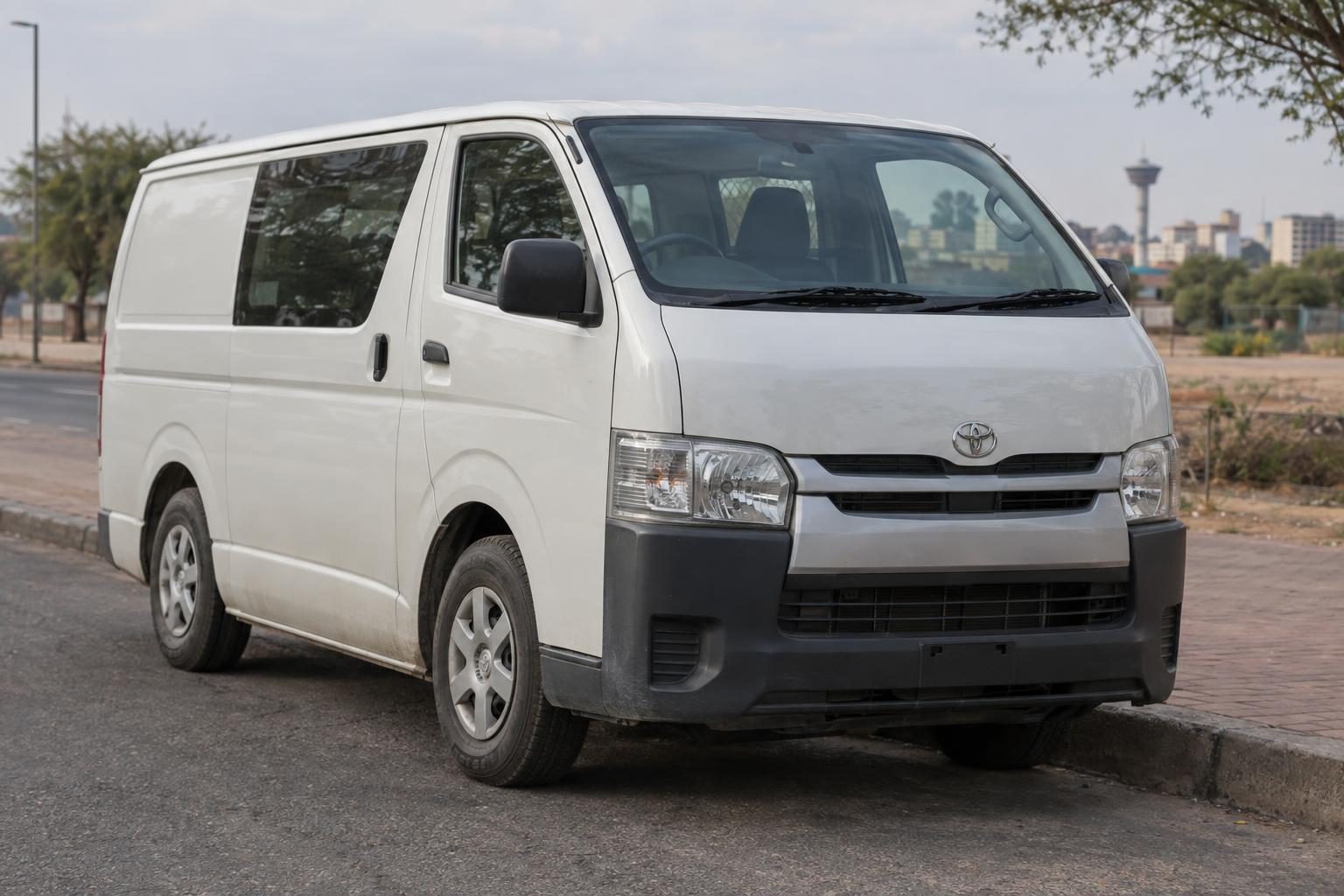 2023 Toyota Hiace — Petrol (TRH200K)
The specification is the familiar TRH200K package: 1TR-FE 2,000 cc inline four producing 136 PS, automatic transmission, rear-wheel drive, three seats, white paint, 18 m³ of listed load space, and the 4,695 mm by 1,695 mm by 2,240 mm high-roof body on a 2,570 mm wheelbase. Air conditioning, airbags, UV filter glass, power windows, ABS, traction control, EBD and brake assist are all listed.
At this mileage a Japanese van has normally seen three or four scheduled services, so the book should show stamps. Check brake wear front and rear, look around the rocker cover for oil weeping, and inspect the cargo floor for stress marks where loads have shifted. Tyres are probably still the originals, so measure tread across the full width rather than at one point, since uneven wear points at alignment rather than age. The 1TR-FE is nowhere near stressed at 42,000 km, but it still pays to listen at cold start for any chain noise. This van suits someone who wants recent build quality and will accept honest use in exchange for a lower price.
The Diesel Hiaces: More Torque, More to Check
The 1GD-FTV vans are the workhorses, and they come with a longer checklist. All three here are 2,800 cc intercooled turbo diesels rated at 151 PS, automatic, on the 1,980 mm standard-roof body with 16 m³ of load space. Mileage runs from 88,000 km to 169,000 km, and the grades run from 3 to 3.5. That spread is exactly why inspection depth matters.
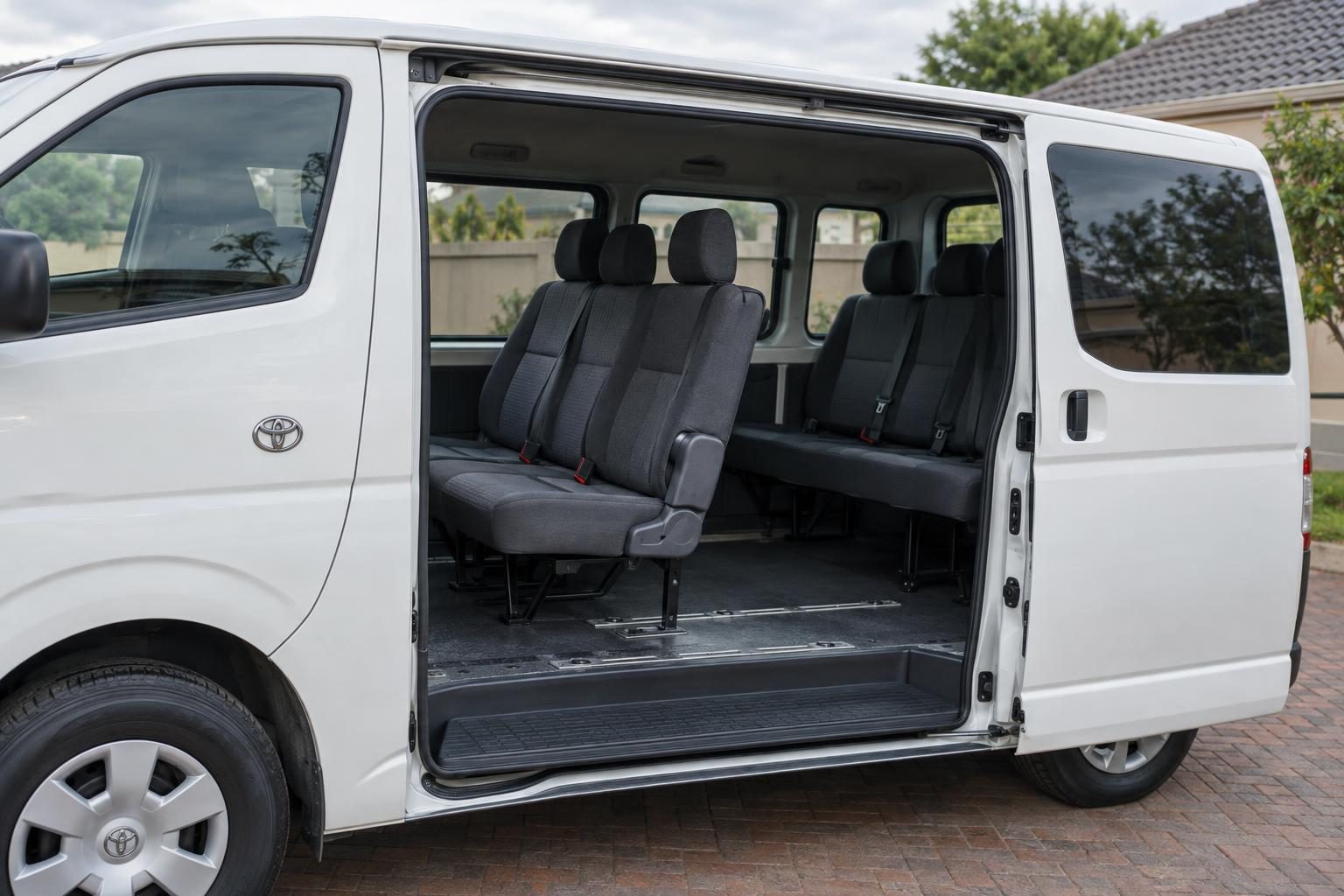 Open side door reveals passenger seats, seat belts and floor-mounted rails.
2021 Toyota Hiace Van 5D 4WD DX, Grade 3.5 at 88,000 km
The 2021 Toyota Hiace diesel 4WD is probably the most balanced van in this whole group. At 88,000 km the 1GD-FTV is mid-life, comfortably short of the mileage band where injectors and turbos start asking for money, and the Carbarn inspection records no damage found on either exterior or interior despite the 3.5 auction grade. That combination, average cosmetics with a clean mechanical report, is often where the real value sits.
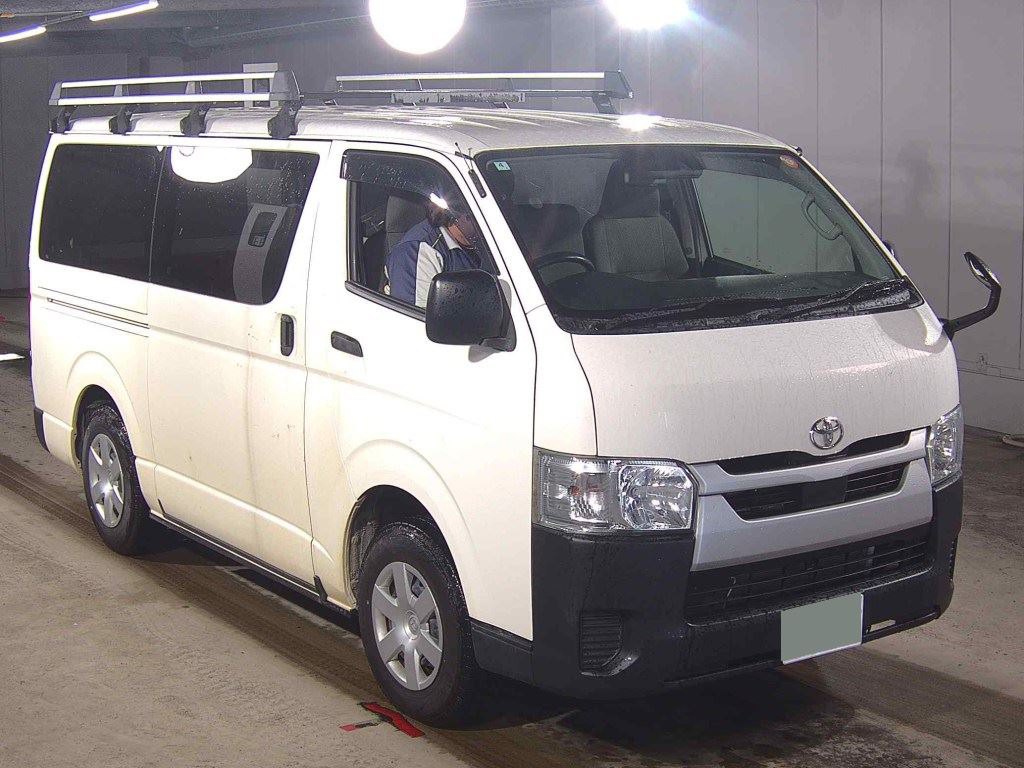 White Toyota Hiace H200 van with roof racks.
Specification reads GDH206V: 1GD-FTV inline four with intercooled turbo, 2,800 cc, 151 PS, automatic, selectable four-wheel drive, three seats, white, 16 m³ of load volume. The body is 4,695 mm long, 1,695 mm wide and 1,980 mm tall on a 2,570 mm wheelbase. Listed equipment includes air conditioning, airbags, power windows, adjustable steering, UV filter glass, seatbelts, ABS, traction control, EBD, brake assist and an anti-theft system.
On the engine, three checks come first. Watch for blue smoke at cold idle, which points to turbo seals, and again under hard acceleration, which points to the compressor wheel. Look for carbon around the EGR and throttle body, because a van used on short Japanese commutes carbons up faster than one that ran highways. Listen at first start for chain rattle that clears once oil pressure builds.
Then do the 4WD work. Engage and disengage the system, feel for grinding, check the transfer case front output seal for weeping, and inspect both front CV boots for cracks. On the transmission, a smooth progression through every gear matters more than anything else. Hesitation or hunting between second and third is the earliest honest warning you'll get. This van fits a business that needs occasional gravel or farm access without taking on high-mileage risk.
2020 Toyota Hiace Van Long DX, Grade 3 at 91,000 km
The 2020 Toyota Hiace diesel carries the lowest grade here at 3, and it is the most interesting van in the group precisely because the inspection report explains why. The Carbarn report lists three notes: minor surface marks and a small dent on the lower side panel, a patchy dull area with light marks on the rear fender, and light scratches on the rear bumper. Every one of those is panel cosmetics. None of them is structural.
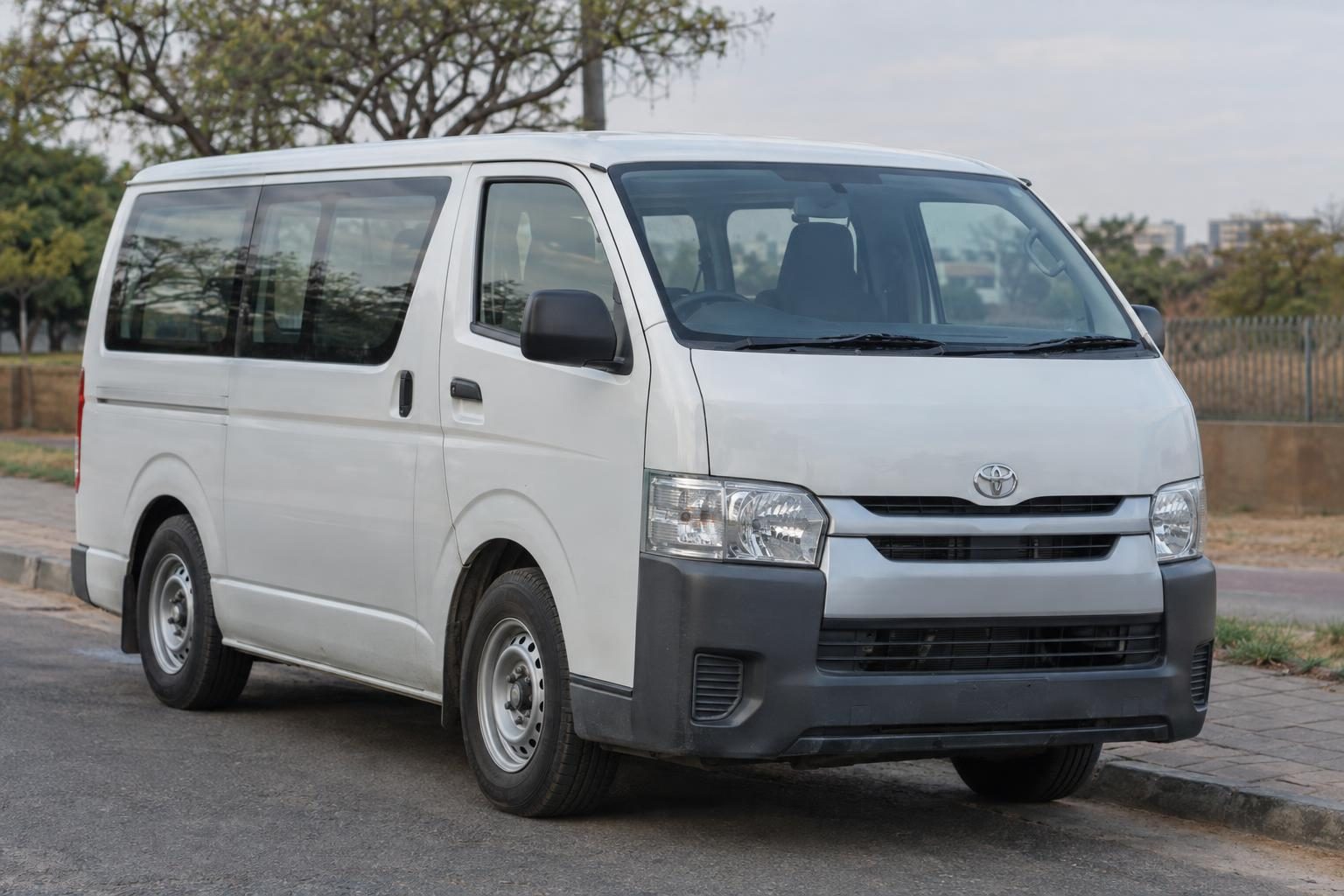 2020 Toyota Hiace — Diesel (GDH201V)
The hard data backs that reading. Tyre condition is rated good with 6 mm of tread front and rear, the underbody is recorded as clean, the windscreen is undamaged, the dashboard is undamaged, and the interior has no burn holes and a normal smell. On specification it is a GDH201V: 1GD-FTV 2,800 cc intercooled turbo diesel, 151 PS, automatic, rear-wheel drive, three seats, white, 16 m³ of load space, 4,695 mm by 1,695 mm by 1,980 mm on the 2,570 mm wheelbase, with air conditioning, airbags, UV filter glass, ABS, traction control, EBD and brake assist.
So what do you still check at 91,000 km? Ask about a compression test. Look for black carbon staining around the injector bodies, which signals seal leaks. Establish whether the diesel particulate filter has ever been cleaned, since short urban use in Japan clogs them. Rear-wheel drive keeps the rest simple with no transfer case and no CV boots to worry about. This is a cargo buyer's van: the cheapest diesel in the group, honest about its scuffs, and worth having a Gaborone mechanic review the inspection report alongside you before you commit.
2021 Toyota Hiace Van 5D 4WD DX GL Package, Grade 3.5 at 169,000 km
The 2021 Toyota Hiace diesel GL Package is the highest-mileage van here, and it is the one that most rewards a careful reader. Its Carbarn inspection carries two notes: a noticeable crack on the rear light cover, and a crack with minor surface marks on the front bumper. Cracks at both ends of a van tell you something beyond cosmetics. This one has taken knocks, so read the auction sheet for any markings near structural points before anything else.
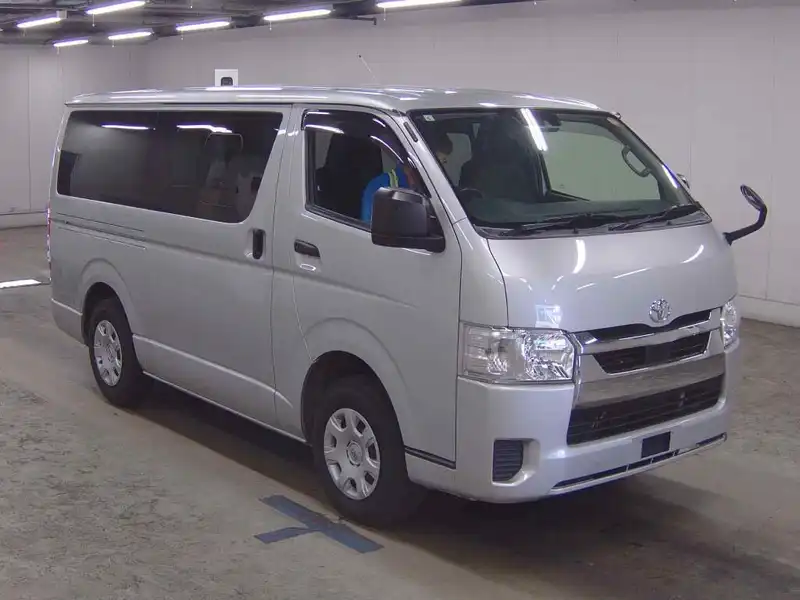 Silver Toyota Hiace H200 facelift van in an indoor inspection lane.
The rest of the report is more reassuring than the mileage suggests. Underbody is recorded as clean, windscreen and dashboard undamaged, tyre condition good, interior free of burn holes with a normal smell. Specification is GDH206V: 1GD-FTV 2,800 cc intercooled turbo diesel, 151 PS, automatic, four-wheel drive, six seats in GL Package trim, silver, 16 m³ of load volume, 4,695 mm by 1,695 mm by 1,980 mm on the 2,570 mm wheelbase, with air conditioning, airbags, power windows, UV filter glass, adjustable steering, ABS, traction control, EBD, brake assist and anti-theft.
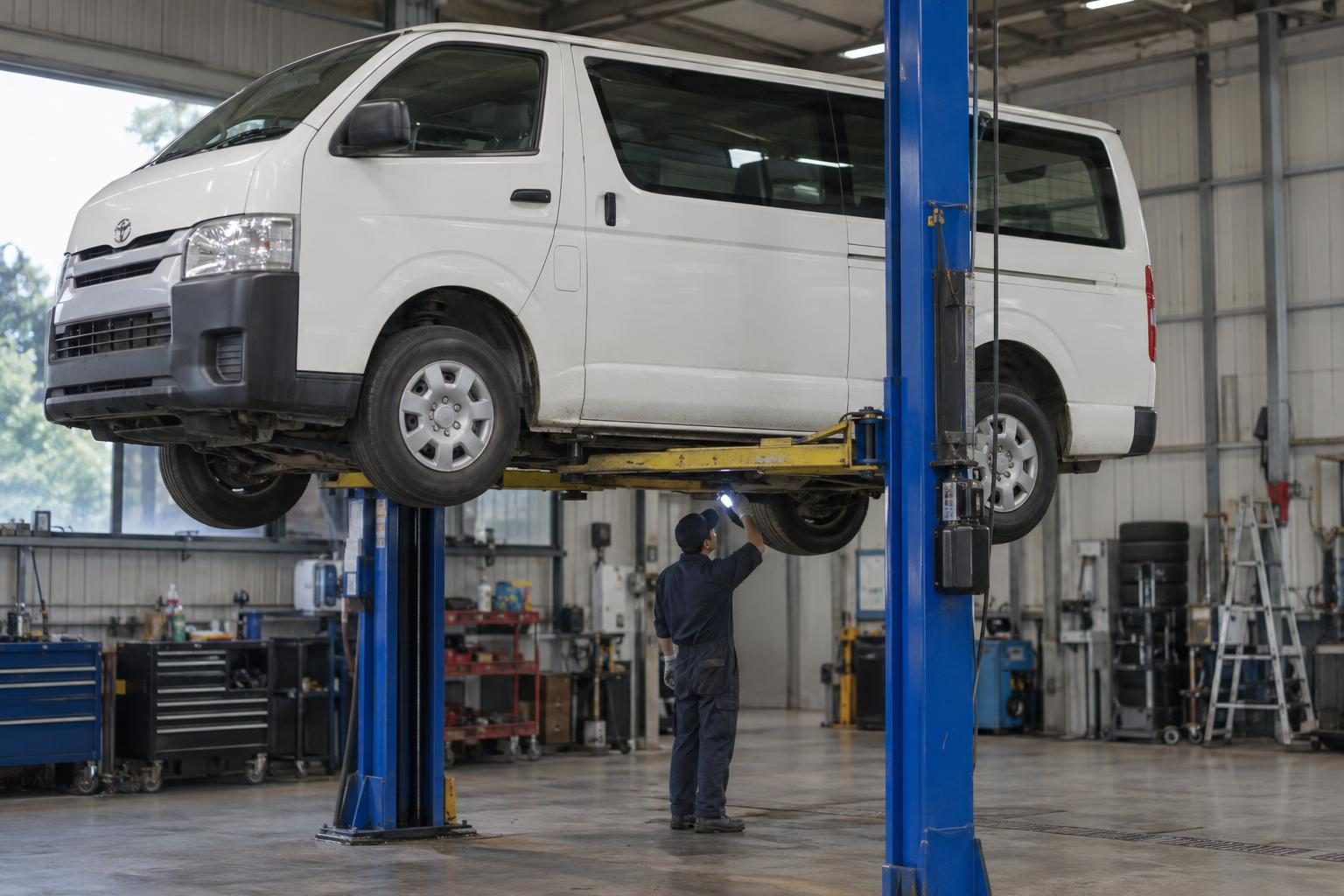 A Toyota Hiace on a workshop lift during an underbody inspection.
At 169,000 km the turbo is your first priority, not your last. Blue smoke under load, oil film inside the intercooler piping, or heavy breather blowby all suggest it is winding down, and a turbo replacement is among the most expensive non-catastrophic jobs on this engine. Get a written quote from a diesel specialist in Gaborone before you commit, and treat that figure as part of your purchase price. Injectors are commonly planned for around 200,000 km on these engines (ReDriven), so you are buying inside that window.
Add the 4WD checks from the 88,000 km van and apply them harder. Some mechanics also report valvetrain wear appearing on higher-mileage 1GD units (MotorReviewer), so listen for ticking from the top end at warm idle. Put the van on a lift and look at rear cross-members and outriggers, because Japanese winter road salt does eventually show. This is a van for an experienced buyer who knows these checks, wants the GL interior and 4WD, and has budget set aside. It is not a first import.
What Should You Check on Every Hiace Before You Buy?
Run the same sequence on every van regardless of grade, because the auction sheet describes a moment in time and the mechanical picture is yours to build. Engine, underbody, interior, then drive. Four stages, in that order, with the auction sheet and the inspection report open next to you.
Engine Bay
- Cold-start smoke. Blue points at turbo seals, white points at something worse on a diesel
- Oil level and colour. Black sludge means services were skipped
- Coolant expansion tank. Oily residue is a head gasket signal
- Intercooler piping. Oil film inside means turbo blowby
- EGR and throttle body area. Heavy carbon suggests a short-haul life
- Battery and terminals. Botswana heat shortens battery life, so a tired one is a near-term cost
Underneath
- Chassis rails at the joins, plus rear outriggers and floor cross-members
- Exhaust for cracks, heavy scale or patched holes
- Gearbox and differential for wet dark patches with dust stuck to them
- On 4WD vans only: front CV boots for splits, and the front differential plug for recently changed oil
- Tyre manufacture date, read from the four-digit code on the sidewall. Four years or older means budgeting for replacements
Interior
- Floor panels for lifting, rust bubbling or a damp smell, which means water is getting past a seal
- Every seat mount for movement, and every belt and latch for function
- Dashboard warning lights at cold start. They should all extinguish within about 30 seconds. A DPF or EGR light that stays lit is a stop-and-ask moment
Test Drive
- Smooth progression through every gear with no hunting between ratios
- Clean turbo pull from around 1,800 rpm, not sluggish or surging
- Straight-line braking with no pedal vibration
- 4WD engaging and releasing cleanly in a safe open area
- Listening throughout for chain rattle at cold idle, bottom-end knock under load, and differential whine at speed
On an import, you run most of this through documentation and your clearing-side mechanic rather than in person. That is why the paperwork quality matters so much, and why a van with a thin inspection report should cost less than one with a detailed clean one.
Which Red Flags Should Stop the Purchase?
Some findings are negotiating points. A few should end the conversation. The clearest is the auction grade itself: an R or RA grade means recorded structural repair, usually crash or flood related, and no price makes that worth the risk in a working van.
The rest of the list, roughly in order of severity:
- Oil pooling in the intercooler piping on a diesel. That is turbo failure already underway, not a future risk
- Blue smoke under acceleration that never clears. Same conclusion, now visible from the pavement
- Auction sheet markings near frame rails or structural points. Even when described as cosmetic, get a mechanic's second read before you pay
- No service stamps at all above 80,000 km. It happens, but on a common-rail diesel it is a real risk to injectors and the EGR system
- A DPF warning light that stays on. A blocked filter that has never been serviced is a known cost, so confirm its condition rather than hoping
- Split CV boots on a 4WD van. Grit and water in the joint means failure is coming. Use it to negotiate if the price already reflects it, rather than walking automatically
None of these need guesswork. Every one is visible in photographs, in the inspection report, or in a question you can ask before you transfer money.
Which Hiace Makes Sense for Your Situation?
Match the van to the work, not to the grade. With 79.6% of Botswana's first-time registrations in Q4 2025 being used vehicles (IndexBox / Statistics Botswana), you are buying in a market where used is normal and condition judgement is the skill that separates a good purchase from an expensive one.
| Your situation |
The van that fits |
| City delivery work, small maintenance budget |
2022 or 2023 petrol, grade 4 to 4.5, rear-wheel drive |
| Staff or family transport, want simplicity |
2021 petrol DX, six seats, grade 4 |
| Inter-town cargo, high annual distance |
2021 diesel GDH206V, grade 3.5, 88,000 km |
| Farm or lodge access on gravel and sand |
Either 4WD diesel GDH206V, if the turbo checks out |
| Lowest diesel price, confident inspecting |
2020 diesel GDH201V, grade 3, 91,000 km |
| Maximum seats plus 4WD, experienced buyer |
2021 diesel GL Package, 169,000 km |
A few plain observations to finish the picture. Petrol buyers never have to think about EGR carbon, DPF regeneration or fuel-quality sensitivity, which is worth more than the brochure suggests if your van lives in traffic. Diesel buyers get the economy and the long life, but they inherit a maintenance schedule and should price wear items into the purchase rather than discovering them later.
And grade is not destiny. The grade 3 van here has 6 mm of tread, a clean underbody and three noted panel scuffs. The grade 3.5 van has cracks at both ends. Read the detail, not the number.
How Does Buying a Hiace Direct from Japan Work?
Carbarn is a Japanese-owned exporter operating from Yokohama under Carbarn LLC, holding Motor Dealer Licence 452570013005. It is not a Botswanan company, not a branch, and not a local dealership, which is worth stating plainly so you know who you are contracting with. Every van listed for Botswana is already owned by Carbarn before it appears, so there is no broker in the middle and no third party able to cancel your order. Two documents reach you before you pay: the official Japanese auction sheet from the auction appraiser, and an in-house Carbarn inspection report with its own condition notes. Those are the two papers that make every check in this article possible from Gaborone. Each vehicle page carries an "Estimated landed cost in Botswana" panel showing the vehicle price with shipping and inspection included, alongside the duties that remain your responsibility, with customs duty of approximately 27% of CIF value per Carbarn's import rules and regulations page. Clearance, registration and licensing sit outside that figure too, so confirm the final total with your clearing agent and BURS. Vans ship RoRo from Japan to Durban, with Walvis Bay as the alternative port, then travel overland into Botswana, taking approximately 40 days from purchase confirmation to arrival, and Carbarn's stated responsibility ends at the export port. Payment is full settlement before shipment by bank transfer, with details issued only on the official proforma invoice, and no financing or instalment option exists. A self-service dashboard holds your invoice, inspection sheet, bill of lading, certificates and live vessel tracking, and the team can recommend reliable service centres in Botswana, though no warranty is offered on an imported vehicle. You can see the full Toyota Hiace range, browse other Toyota models for Botswana, compare figures in the Toyota specifications database, or read the buying guide before you start.