A premium Japanese import can look affordable until shipping, customs duty, VAT, clearance, registration and licensing enter the calculation. The Toyota Crown Sport is especially easy to judge from its Japanese purchase price alone.
This guide follows the whole journey, from checking the exact vehicle in Japan to shipping through Durban, clearing it and registering it in Botswana. The question is simple: does the Crown Sport still make financial sense after every required step?
Quick Answer
- Japanese-market Crown Sport examples are normally right-hand drive; confirm the exact vehicle and export documents.
- Botswana’s published import guidance states that there is no general vehicle age limit.
- The Botswana Unified Revenue Service (BURS) assesses charges using the vehicle’s tariff classification, customs value and applicable duties or excise; other charges remain separate.
- The usual route is Japan to Durban, followed by overland movement into Botswana.
- The journey takes about 24 to 34 days from purchase confirmation to arrival, but confirm the estimate for the individual order.
Can a Toyota Crown Sport be imported into Botswana?
Yes, a Toyota Crown Sport can be considered for import if the exact vehicle meets Botswana’s customs, inspection and registration requirements. Botswana has no general vehicle age limit, while Japanese-market examples are normally right-hand drive. Toyota launched the model in Japan in 2023 (Toyota Global, “Toyota Launches All-New Crown ‘Sport’ in Japan,” 2023).
The Botswana import rules state that there is no general import age limit. The exact chassis, powertrain and paperwork still need checking before approval. Confirm the current position with BURS before payment.
Toyota launched the Crown Sport in Japan in 2023. The Sport Z HEV uses a 2.487-litre series-parallel hybrid system, E-Four electric four-wheel drive and Toyota’s published 21.3km/L WLTC fuel figure (Toyota Global, “Toyota Launches All-New Crown ‘Sport’ in Japan,” 2023).
A vehicle being suitable for shipment is not the same as being ready for registration. Customs valuation, police inspection, identity checks and registration still apply. Confirm the model code, steering position and export documents before making a payment.
What should you check before paying for the vehicle?
Before payment, verify the exact Crown Sport, its documents and the costs that remain outside the supplier’s stated price. A proforma invoice should identify the vehicle, price, shipping and inspection inclusions. The how the Japan buying process works can then be checked against the individual order.
Confirm the current BURS clearance deadline directly before payment. Accurate paperwork still matters, because missing invoices or incorrect declarations may delay clearance or require further clarification. Do not rely on an undated or inaccessible secondary notice as the sole evidence for a deadline.
Use this checklist before committing:
- Confirm the exact Crown Sport grade and model code.
- Check the chassis number and right-hand-drive configuration.
- Confirm whether it is the HEV or PHEV version.
- Review the auction sheet, auction grade and condition notes.
- Read the inspection report and defect comments carefully.
- Check battery or hybrid-system information where available.
- Confirm the export certificate, invoice and later bill of lading process.
- Research local diagnostic equipment and parts support.
- Check the tyre size and likely replacement cost.
- Separate the quoted import price from the final Botswana road cost.
The Toyota Crown vehicles page is useful for reviewing related models, but it does not confirm that a Crown Sport is listed. An individual vehicle page and final proforma invoice are needed for a reliable estimate.
What does the Toyota Crown Sport import price actually include?
The Japanese vehicle price is only one part of the final cost. BURS assesses the vehicle using its tariff classification and customs value, while shipping, duty, clearance, registration and licensing may sit outside the supplier’s stated price. Customs duty is described as approximately 27% of CIF value in the Botswana import rules, but the final assessment must be confirmed.
| Cost stage |
What it means |
| Vehicle price |
The value of the exact vehicle on the supplier invoice |
| Shipping and inspection |
May form part of the supplier’s stated import price |
| CIF value |
Cost, insurance and freight, used as one part of customs valuation |
| Customs duty |
Based on the vehicle’s tariff classification and applicable assessment, not a universal rate |
| VAT and assessed taxes |
Budget separately; the applicable amount must be confirmed |
| Port and clearance costs |
Charges connected with clearing the vehicle |
| Inland transport |
Movement from the regional port towards Botswana |
| Registration and licensing |
Government costs before road use |
| Insurance and collection |
Buyer-arranged costs after clearance |
CIF means cost, insurance and freight. It can form part of customs valuation, but it is not the final registered price and does not by itself determine the duty rate. A higher transaction or assessed value may increase tax exposure, depending on the tariff classification and applicable assessment.
To judge whether the import makes sense, compare the estimated landed cost with similar premium crossovers already available in Botswana. Allow separately for duty, VAT, clearance, registration, licensing, tyres, diagnostics and possible parts delays. A lower Japanese price is not enough if the completed cost removes the Crown Sport’s value advantage.
Do not calculate an exact Toyota Crown Sport landed price without a confirmed vehicle, CIF value and current assessment. Instead, check the vehicle page’s Estimated landed cost in Botswana panel when an exact listing exists.
The Terms and Conditions also explain what the listed price does and does not include.
How does shipping from Japan to Botswana work?
Shipping usually follows a sea route from Japan to Durban, followed by overland movement into Botswana. The journey takes about 24 to 34 days from purchase confirmation to arrival, although port schedules, inland transport and clearance can affect the actual timing (How to Buy guide, 2026).
Botswana is landlocked, so a vehicle normally travels by sea to a regional port before moving overland into the country.
The practical sequence is:
- Select and verify the exact vehicle in Japan.
- Confirm the destination port and proforma invoice.
- Complete the required payment before shipment.
- Finish inspection and export documentation.
- Ship the vehicle by roll-on, roll-off, or RoRo.
- Receive it at Durban, with Walvis Bay as an alternative where applicable.
- Move it overland towards Botswana.
- Complete customs, police clearance and registration.
RoRo means roll-on, roll-off shipping. Vehicles are driven onto a vessel and secured for the sea journey. Confirm whether the quoted timeframe runs from purchase confirmation, full payment, shipment departure, Durban arrival or arrival in Botswana. Arrival at Durban also does not mean the vehicle is cleared or registered.
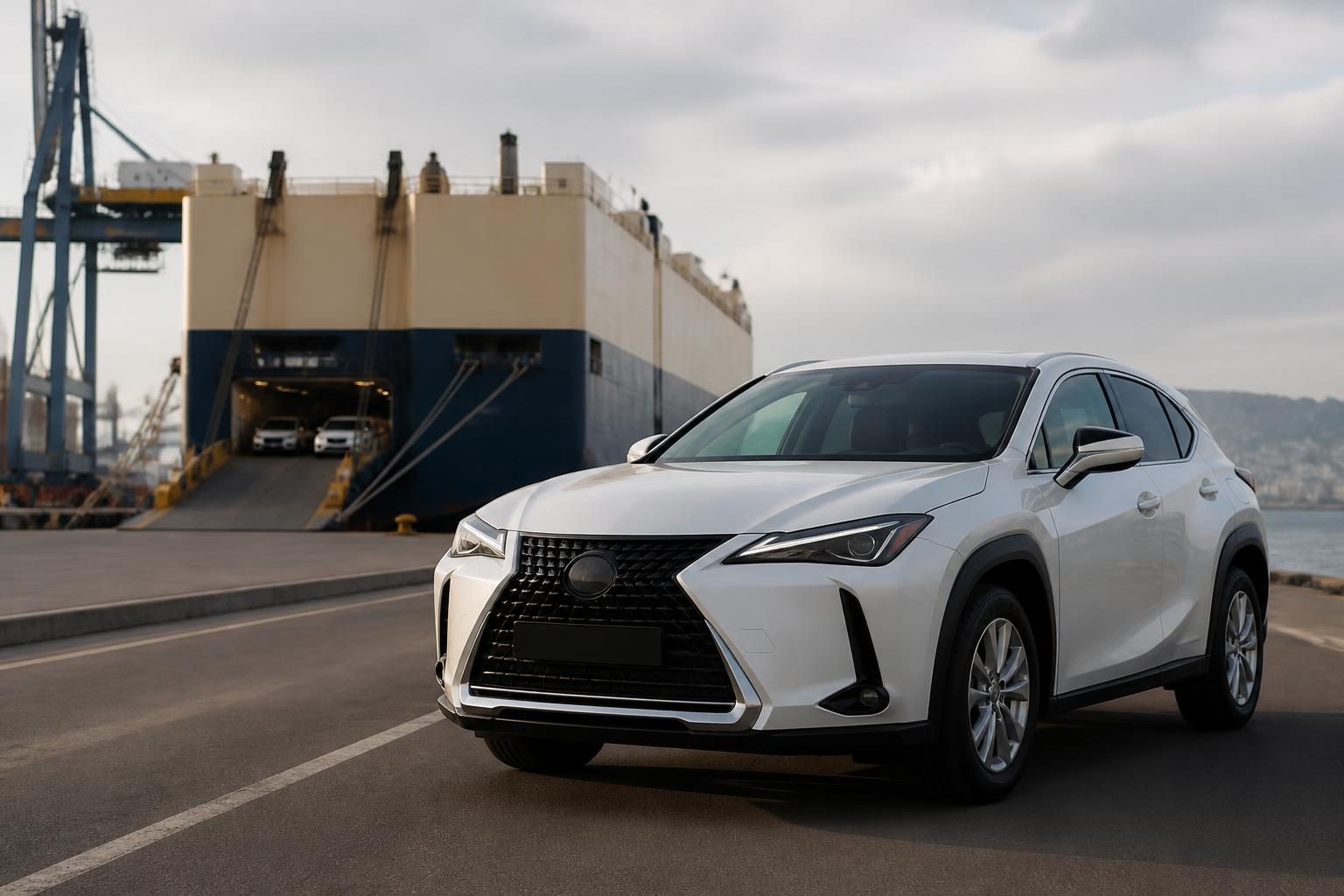 The usual route runs from Japan to Durban, followed by overland movement into Botswana.
What documents are needed for clearance and registration?
Clearance and registration require consistent evidence of the vehicle’s identity, ownership, value and condition. In 2026, the Government of Botswana’s Vehicle Import/Export Clearance service states that imported vehicles require physical inspection, an invoice and a bill of lading. It lists a normal clearance time of 24–48 hours once the vehicle and documents are presented.
| Document |
Why it matters |
| Purchase invoice |
Confirms the transaction and declared value |
| Export certificate |
Supplier/export evidence; confirm whether it is included for the individual order |
| Bill of lading |
Carrier/shipping document identifying the shipment and sea transport; required as supporting evidence for applicable imports |
| Auction sheet |
Supplier evidence of Japanese auction condition and grade |
| Inspection report |
Supplier evidence of observed condition and defects |
| Police clearance |
Government clearance supporting registration |
| Customs clearance |
Required before registration |
| Manufacturer’s certificate |
Confirm with the registration authority if required |
| RV 1 form |
Used in the registration process |
| Roadworthiness certificate |
Required for vehicles more than three years old |
| SAD 500 declaration |
Customs-process document where applicable |
An RV 1 is the registration form used in the vehicle-registration process. A SAD 500 is a customs declaration used where applicable. The Government’s registration guidance says applicants need police and customs clearance.
Vehicles more than three years old, measured from the year of manufacture, must also pass a roadworthiness test. Keep every invoice, export certificate, inspection report, payment record and shipping document together. The paperwork should tell one consistent story about the vehicle’s identity, ownership and value.
What happens after the vehicle arrives in Botswana?
After arrival, the buyer must complete customs, police clearance and registration before using the vehicle on the road. In 2026, the Government of Botswana says police vehicle clearance normally takes 24–48 hours after physical inspection and document submission. Registration also requires customs clearance, police clearance and the prescribed fee (Vehicle Registration and Licensing, 2026).
After arrival, the usual responsibilities include:
- Making the customs declaration and paying assessed charges.
- Arranging clearing-agent support if you use one.
- Presenting the vehicle for police inspection.
- Obtaining the relevant BP17B clearance for registration.
- Completing roadworthiness testing if the vehicle is more than three years old.
- Submitting the RV 1 registration form.
- Paying registration and weight-related licensing fees.
- Renewing the vehicle licence annually.
BP17B is the Botswana Police form for motor vehicle clearance for registration, according to the Government clearance page. It is separate from shipping and should be planned as part of the ownership process.
Is the Toyota Crown Sport a sensible Botswana import?
The Toyota Crown Sport can make sense for a buyer who wants a newer premium Japanese crossover and has separate funds for duty, clearance and registration. Toyota published a 21.3km/L WLTC figure for the Crown Sport Z HEV in 2023, but actual fuel use depends on traffic, speed, load, terrain and driving style (Toyota Global Crown Sport launch, 2023).
HEV means hybrid electric vehicle. The petrol engine and electric motor work together, with the battery charged through the vehicle’s system rather than a plug. PHEV means plug-in hybrid electric vehicle, which can also be charged externally.
| Makes more sense for |
Might not suit |
| Buyers wanting a newer premium Japanese crossover |
Buyers focused on the lowest ownership cost |
| Owners who can fund the purchase before shipment |
Buyers who need finance or instalments |
| Buyers with a separate budget for duty and clearance |
Buyers comparing only the Japanese price |
| Drivers who value quiet hybrid urban driving |
Buyers needing the cheapest, simplest parts |
| Owners prepared to confirm hybrid diagnostic support |
Buyers who require a local test drive or warranty |
The Crown Sport Z HEV is 4,720mm long, 1,880mm wide and 1,565mm high. Toyota also specifies 21-inch tyres, while the published AZSH36W reference lists 235/45R21 tyres (Toyota Global, “Toyota Launches All-New Crown ‘Sport’ in Japan,” 2023). Before importing, obtain local quotes for replacement tyres, diagnostics and electronic components, because these costs may be higher than for a Corolla or Aqua.
The PHEV is a separate choice. Toyota publishes 20.3km/L WLTC in hybrid mode and up to 90km of WLTC electric range for the Sport RS PHEV (Toyota Global, “Crown Sport PHEV,” 2023). Consider it only after checking charging access, electrical support and the exact Japanese specification.
What can a verified Crown example teach you about the process?
A real Japanese import record is useful for checking vehicle identity, reports and cost documents, but it does not prove that every related model is available or suitable. A 2018 Toyota Crown shows the type of information a buyer should review before committing to a Crown Sport.
A 2018 Toyota Crown can show how model code, auction information, mileage and inspection records fit together. It is a process example, not evidence of a Crown Sport listing. Use the same checks for the exact vehicle being considered.
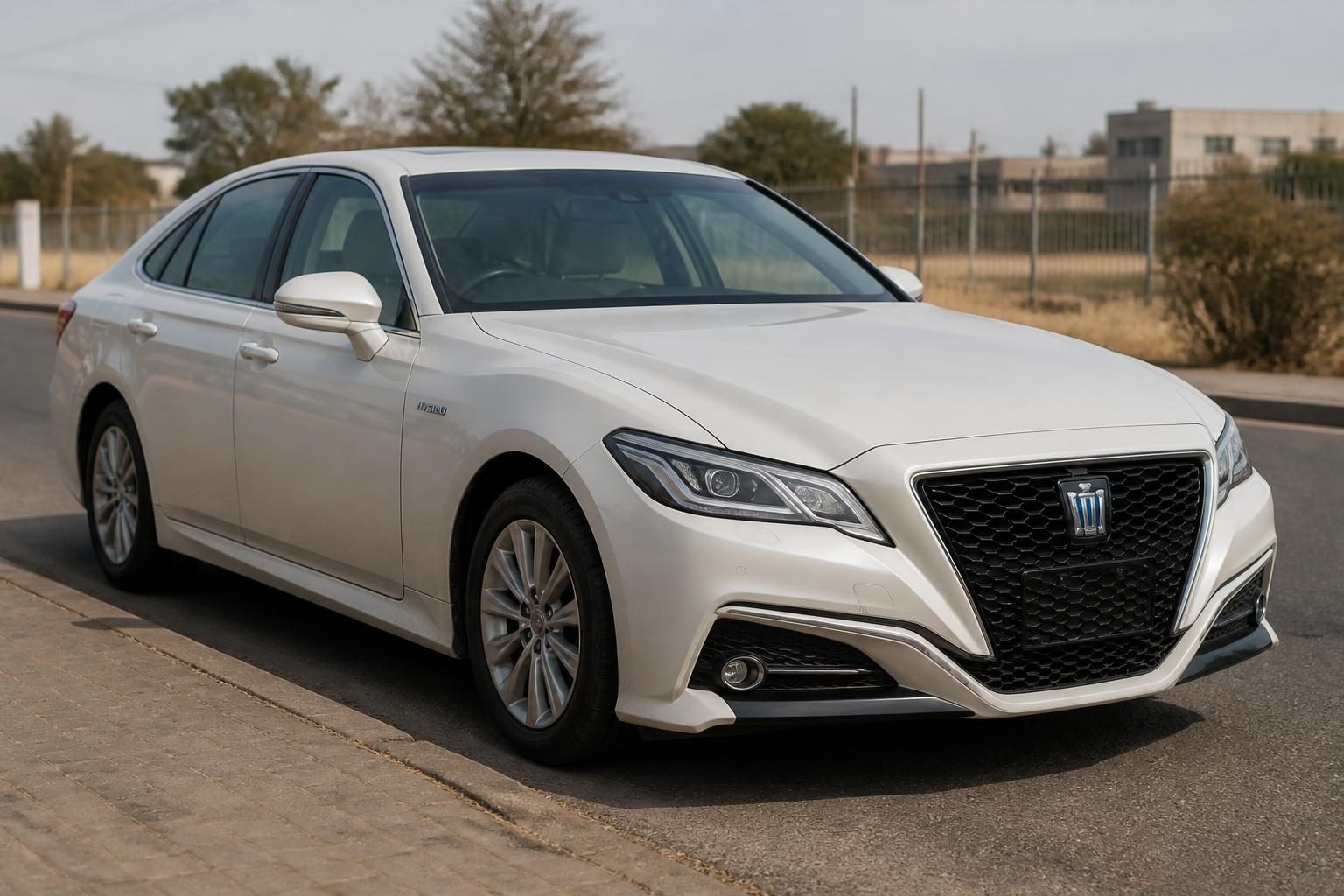 2018 Toyota Crown
The vehicle page records 87,000km, auction grade 4.5 and dimensions of 4,910mm long, 1,800mm wide and 1,455mm high. It is a useful example of checking reports, model identity and an individual landed-cost estimate. It is not evidence of a Crown Sport listing.
How can a Japan-based exporter fit into the import process?
A Japan-based exporter can help organise vehicle selection, inspection, shipping documents and tracking, but it does not remove the buyer’s Botswana-side responsibilities. The journey takes about 24 to 34 days from purchase confirmation to arrival, with customs clearance, registration and licensing still handled as separate steps.
The service model can reduce paperwork uncertainty, but it does not remove the buyer’s legal and financial responsibilities. Review the invoice, reports, route, exclusions and exact vehicle specification before paying.
Carbarn operates internationally from Japan under Carbarn LLC, not as a Botswana legal entity, branch, dealership or showroom. It provides an official Japanese auction sheet and an in-house inspection report before payment. Check the individual proforma invoice to confirm which vehicle, shipping and inspection costs are included in its stated price. Full payment is required before shipment. Its dashboard provides invoices, inspection sheets, bills of lading, live vessel tracking and any export certificate supplied for the individual order, while support runs through Japan, email and WhatsApp. The usual route is RoRo from Japan to Durban, or Walvis Bay where applicable, followed by overland movement. Customs duty, VAT, clearance, registration and licensing remain the purchaser’s responsibility, and responsibility ends at the designated export port. Review the five-step import process, Botswana import rules and the Toyota Crown vehicles page before requesting an exact landed-cost estimate.