A Suzuki Jimny can look almost toy-sized beside a Toyota Prado. That does not make it a less serious off-road vehicle. This Suzuki Jimny vs Toyota Prado comparison is written for Botswana buyers. The Jimny suits a buyer who spends the week around Gaborone and explores gravel, sand or rough tracks at weekends.
The Prado solves a different problem. It carries more people, luggage and equipment, then makes long inter-town journeys easier. So, which is the better 4x4 for Botswana? The honest answer depends on what you carry, where you drive and which compromise you can accept every week.
Quick Answer
- Choose the Jimny for compact dimensions, genuine low-range 4WD and likely lower fuel and tyre costs.
- Choose the Prado for family space, long-distance comfort, luggage and heavier loads.
- In 2024, Suzuki’s matching Jimny Sierra manual figure was 15.4 km/L WLTC (Suzuki Japan, “Jimny and Jimny Sierra specification update”, 2024).
- A selected 2015 Prado diesel recorded 11.8 km/L JC08, but the two test cycles are not directly equivalent (Toyota Japan, “2015 Land Cruiser Prado TX L Package vehicle information”, 2015).
- The right choice depends more on passengers, luggage and road type than reputation.
What Are You Actually Comparing?
The 2024 Jimny Sierra is a compact four-seat 1.5-litre petrol 4x4, while the selected Prado is a larger seven-seat 2.8-litre diesel SUV. Suzuki’s official specification confirms ladder-frame construction and low-range 4WD. Toyota’s 2015 data describes a larger touring vehicle. These are different kinds of 4x4 ownership, not close-size alternatives.
A ladder frame uses a separate chassis beneath the body. Low range provides slower, more controlled gearing on steep or loose ground. An auction grade is a Japanese auction assessment, so it should be read with the detailed inspection report.
WLTC is a newer fuel-economy test cycle designed to reflect several driving conditions. JC08 is an older Japanese test cycle. The results should not be compared as though they used the same laboratory method.
This comparison uses the 2024 four-seat Jimny Sierra as the main small-4x4 example. It also explains how the 2025 660 cc Jimny differs. The Prado figures come from one selected 2015 TX L Package diesel grade, not every Prado.
For broader model information, compare the Suzuki specifications available in Botswana with the Toyota specifications available in Botswana.
The useful question is not whether the Prado is “better” because it is larger. The real question is whether you need a narrow trail tool or a vehicle that carries people and equipment across long distances.
Jimny vs Prado: Key Differences at a Glance
The Jimny is the easier vehicle to place in tight spaces, while the Prado offers more power, seats and carrying capacity. In 2024, the Jimny Sierra measured 3,550 mm long and produced 74 kW. Toyota’s selected 2015 Prado measured 4,760 mm and produced 130 kW (Toyota Japan, “2015 Land Cruiser Prado TX L Package vehicle information”, 2015).
| Area |
2024 Suzuki Jimny Sierra |
2025 Suzuki Jimny kei |
Selected 2015 Toyota Prado diesel |
| Engine |
1,500 cc K15B petrol |
660 cc R06A turbo petrol |
2,754 cc 1GD-FTV turbo diesel |
| Power |
74 kW / 101 PS |
47 kW / 64 PS |
130 kW / 177 PS |
| Torque |
130 Nm |
96 Nm |
450 Nm |
| Transmission |
Manual |
Manual |
Six-speed automatic |
| Drivetrain |
Part-time 4WD |
Part-time 4WD |
Full-time 4WD |
| Seats |
4 |
4 |
7 |
| Length |
3,550 mm |
3,395 mm |
4,760 mm |
| Width |
1,645 mm |
1,475 mm |
1,885 mm |
| Published fuel figure |
15.4 km/L WLTC |
16.6 km/L WLTC |
11.8 km/L JC08 |
| Best role |
Compact trails and small households |
Light, narrow-track use |
Family touring and heavy loads |
Suzuki’s 2024 release lists 15.4 km/L WLTC for the manual Sierra and 16.6 km/L WLTC for the manual kei Jimny. Toyota’s selected 2015 diesel records 11.8 km/L JC08. The figures describe different variants and test cycles, so they should not be treated as a laboratory head-to-head result.
The Prado figure comes from one selected 2015 diesel variant. Fuel cycles also differ, so this table shows published specifications rather than a direct fuel-cost ranking.
Why Does the Suzuki Jimny Suit Some Botswana Buyers?
The Suzuki Jimny suits buyers who want a compact vehicle with genuine low-range 4WD ability. In 2024, Suzuki’s official Sierra specification listed 74 kW, 130 Nm and 210 mm of ground clearance (Suzuki Japan, “Jimny Sierra Performance and Environmental Performance”, 2026).
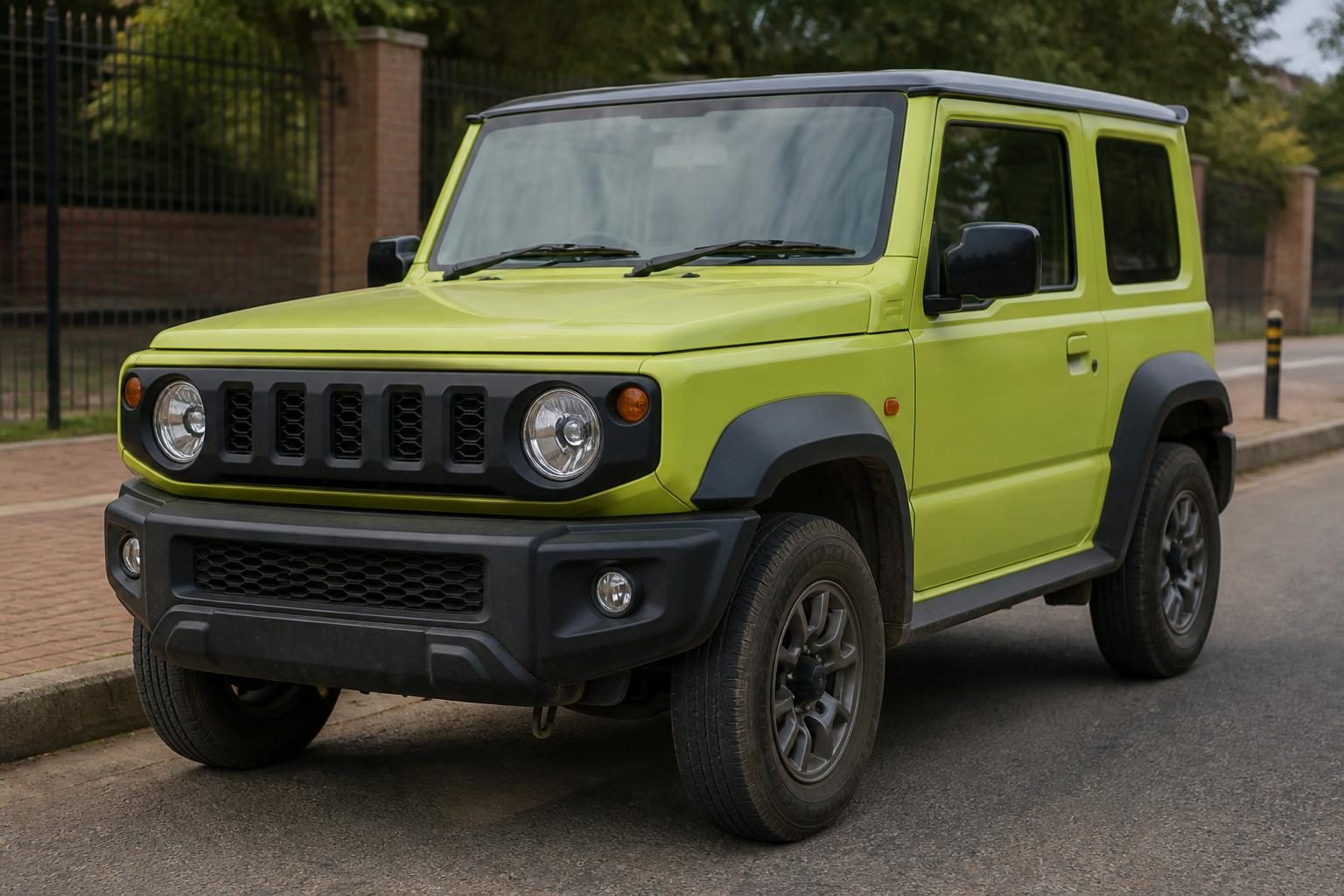 2024 Suzuki Jimny
The 2024 example is a SIERRA JL with a 1,500 cc petrol engine, manual gearbox, 4WD, four seats and 5,000 km. Its model code is JB74W. The vehicle record shows auction grade 5, a clean underbody, good tyres and 4 mm of tread at the front and rear. Those findings apply to this example only, not every Jimny.
Suzuki’s 2024 release gives the matching manual Sierra a published 15.4 km/L WLTC figure. The automatic version records 14.3 km/L WLTC. The Sierra also uses a ladder frame, three-link rigid axles and a transfer lever with 2H, 4H and 4L modes.
That combination makes sense around Gaborone and on narrow tracks. The Jimny is easier to park, turn around and place between obstacles. Its limits are just as clear: four seats, limited luggage space, and, as editorial impressions rather than measured specifications, potentially more road noise and a busier feel when fully loaded.
See the 2024 Suzuki Jimny vehicle report for the auction grade and inspection findings.
What Does the 2025 Kei Jimny Change?
The 2025 Suzuki Jimny vehicle details describe a different vehicle. In 2025, this example used a 660 cc R06A turbo engine, manual transmission, 4WD, four seats and 5,422 km, according to its vehicle record.
Suzuki’s official kei-Jimny specification lists 47 kW, 96 Nm and 16.6 km/L WLTC with the manual gearbox (Suzuki Japan, “Jimny and Jimny Sierra specification update”, 2024). It is 3,395 mm long and 1,475 mm wide, making it narrower than the Sierra.
The vehicle record shows auction grade 5 and no damage found in its inspection result. Do not combine its economy figure with the Sierra’s 1.5-litre performance. The smaller engine may suit buyers prioritising compact urban use, but it offers less reserve for heavy loads and high-speed travel.
Why Does the Toyota Prado Still Make Sense?
The Toyota Prado in Botswana makes more sense when passengers, luggage and long-distance comfort matter. In Toyota Japan’s 2015 data, the selected diesel produced 450 Nm and used full-time 4WD with a six-speed automatic transmission (Toyota Japan, “2015 Land Cruiser Prado TX L Package vehicle information”, 2015).
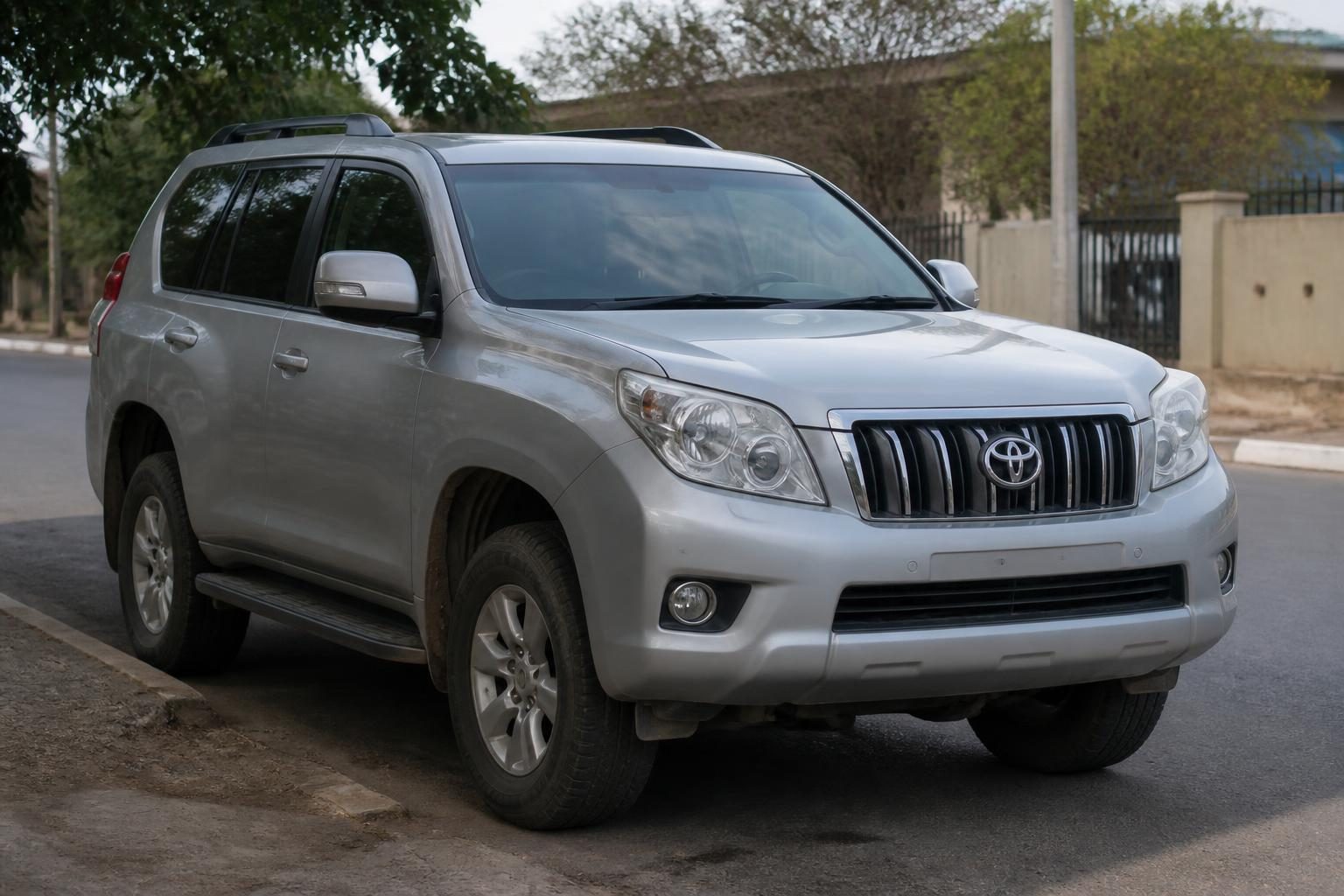 2015 Toyota Prado Example
That selected TX L Package example has a 2,754 cc 1GD-FTV diesel, 177 PS, seven seats and a five-door body. It measures 4,760 mm long and 1,885 mm wide. Toyota’s vehicle information lists an 87-litre fuel tank and a 5.8-metre minimum turning radius (Toyota Japan, “2015 Land Cruiser Prado TX L Package vehicle information”, 2015).
The extra size creates useful reserve. You can carry passengers, water, tools, recovery equipment and camping luggage without filling the cabin immediately. As an editorial impression, the Prado should feel more settled on long inter-town runs than a short, narrow compact 4x4.
The catch is ownership cost and condition. Larger tyres, higher fuel demand and more complex drivetrain systems can increase bills. Check the cooling system, transmission, suspension, underbody, corrosion and 4WD operation before trusting the badge.
The Prado is not automatically the more capable vehicle on every trail. The Jimny can be the more serious tool on a narrow technical route, while the Prado is the more complete expedition vehicle once people, luggage and distance enter the equation.
Which 4x4 Handles Botswana Roads Better?
The Jimny is generally the easier choice for narrow technical tracks, while the Prado is better suited to distance and equipment. In 2023, AutoTrader South Africa’s five-door Jimny road test covered about 800 km through tar, potholes, corrugated gravel, sand, rocks and muddy riverbeds in the Botswana region (AutoTrader, “Suzuki Jimny 5 Door First Drive Review”, 2023).
It is regional evidence from a five-door model, not a direct test of the 2024 three-door Sierra. The result is useful context, rather than proof that every Jimny will behave identically.
- Gaborone errands: The Jimny is easier to park and manoeuvre. The Prado gives families more cabin space and comfort.
- Gravel and potholes: Both need sound suspension, suitable tyres and sensible speeds. Condition matters more than the badge.
- Sand: The Jimny’s lower weight and narrow body can help on tight tracks. The Prado’s torque and carrying capacity help when travelling with people and recovery equipment.
- Long inter-town travel: The Prado offers more comfort and luggage room. The Jimny can manage the journey, but it becomes less relaxed when fully loaded.
- Remote travel: The Prado suits several passengers and equipment. The Jimny suits lighter recreational trips and narrower routes.
Neither vehicle is impossible to bog down. Tyre pressures, driving technique, recovery equipment and route conditions still matter.
For more detail, read the Toyota Prado buying guide for Botswana, including engine, 4WD and buying checks.
Running Costs for the Jimny and Prado
The Jimny may use less fuel and cheaper tyres, but a sound Prado can be better value than a neglected compact 4x4. Suzuki’s 2024 figures show 15.4 km/L WLTC for the manual Sierra. Toyota’s selected 2015 diesel recorded 11.8 km/L JC08, and Toyota warns that published test figures vary from real use.
Fuel consumption changes with speed, passengers, luggage, air-conditioning, tyres, sand and corrugated roads. WLTC and JC08 also measure vehicles under different testing systems. There is no reliable percentage saving to claim.
The Jimny’s smaller engine and tyres may reduce routine running pressure. The Prado’s larger tyres, diesel systems and heavier drivetrain can cost more when maintenance has been ignored. Ask about local parts availability, service records and previous towing or off-road use.
A high auction grade helps, but it does not replace a careful review of the vehicle’s reports, underbody and mechanical condition.
Which One Fits Your Life in Botswana?
The Jimny fits buyers who mostly travel alone, as a couple or with a small household. It makes a lot of sense when easy parking, low-range 4WD and narrow-track ability matter more than luggage space or relaxed highway travel.
The Prado fits buyers who regularly carry several passengers, camping equipment, tools or bulky luggage. It is probably the better choice for long inter-town travel, remote touring and heavy loads, provided you accept potentially higher fuel, tyre and maintenance costs.
This buyer-fit matrix is an editorial assessment based on verified dimensions, seating, drivetrain and regional road-test evidence. It is not a measured performance test. Scores indicate relative suitability for each use case, not a guaranteed result.
| Use case |
Jimny |
Prado |
| Gaborone parking and tight streets |
5/5 |
2/5 |
| One or two occupants |
5/5 |
3/5 |
| Seven-person family use |
1/5 |
5/5 |
| Camping luggage |
2/5 |
5/5 |
| Narrow technical tracks |
5/5 |
4/5 |
| Long-distance comfort |
2/5 |
5/5 |
| Fuel-cost sensitivity |
4/5 |
2/5 |
| Carrying passengers and luggage |
2/5 |
5/5 |
The Jimny is the more focused off-road tool. The Prado is the more complete family and touring vehicle. Which compromise will be easier to live with every week?
How Does a Japan-Sourced Jimny Order Work?
A Japan-sourced vehicle is ordered from Japan rather than bought from a Botswana yard. The process involves reviewing the exact vehicle record, auction sheet, inspection report, photographs, quoted inclusions and estimated landed cost before payment.
CIF value means the cost of the vehicle, insurance and freight used for customs assessment. Landed cost means the broader amount needed to bring the vehicle to its destination, including applicable import and local charges.
BURS says Botswana has no general restriction on motor-vehicle imports. Vehicles entering for home consumption still require customs clearance, supporting documents and applicable duties or taxes (BURS, “Clearance of Motor Vehicles”, retrieved 2026-09-02). The government also lists Form BP17B for imported vehicles being cleared for registration (Government of Botswana, “Vehicle Import/Export Clearance”, retrieved 2026-09-02).
The how the Japan-to-Botswana buying process works page explains the general route and documents. The vehicle price is not the final registered total. Customs duty, VAT, clearance, registration and licensing remain separate. Use the vehicle page’s landed-cost estimate and confirm the final figures on the proforma invoice.
RoRo shipping means roll-on, roll-off transport, where vehicles are driven onto and off the ship. It generally follows Japan to Durban, with Walvis Bay as an alternative, before overland movement towards Botswana.
The Japan-based Carbarn service provides an official Japanese auction sheet, an in-house inspection report, photographs, shipping information, a self-service dashboard for invoices, reports, bill of lading and certificates, plus live vessel tracking. The vehicles and documentation originate from Japan. Full payment is required before shipment, and responsibility ends at the designated export port. Vehicles are sold as-is, so check the current terms for available payment options and after-sale coverage before proceeding.
Check the Botswana vehicle import rules for eligibility, clearance and buyer responsibilities.