Choosing between an SUV and a sedan can feel like choosing between lower running costs and extra road clearance. The right answer depends less on the badge and more on your usual routes.
Botswana includes city streets, tarred inter-town highways, maintained gravel, sandy tracks and uneven rural access roads. In 2024, the national road network measured 34,873.3 kilometres, according to Statistics Botswana’s Transport and Infrastructure Statistics Report 2024. That is a wide range of driving conditions.
This guide compares sedans, compact crossovers and genuine 4WD SUVs by road surface, fuel use, luggage needs, inspection evidence and ownership cost. For the import process itself, see this guide to buying a Japanese vehicle.
Quick Answer
- Choose a sedan if you mostly use town roads and tarred highways.
- Choose a compact crossover for regular mixed tar and maintained gravel driving.
- Consider a model-specific 4WD SUV for frequent deep sand, remote tracks or severe rough roads, after checking its actual traction system, tyres and clearance.
- Botswana’s 2024 road network covered 34,873.3 kilometres, so your routes matter more than the SUV badge.
Is an SUV Automatically Better for Botswana Roads?
No. In 2024, Statistics Botswana recorded a national road network of 34,873.3 kilometres in its Transport and Infrastructure Statistics Report 2024. That mix includes tar, gravel, earth and sand or track roads, so an SUV suits some routes better, but not every Botswana driver.
A sedan has a separate boot and a lower driving position. It often weighs less and feels settled on smooth roads. A compact crossover is a raised passenger car designed mainly for road use, rather than a traditional off-road 4WD. It has a taller body, a hatchback opening and more ground clearance.
A 4WD SUV may offer more traction and clearance, but the label alone does not prove serious off-road capability. Check for low-range gearing, differential and traction systems, suitable tyres, ground clearance, underbody protection and any manufacturer-described terrain modes. These features can also bring higher running costs.
The terms matter. SUV does not automatically mean four-wheel drive. Some crossovers send power only to the front wheels. Others use all-wheel drive or a specific 4WD system. Check the exact drivetrain on the vehicle page, model code and auction documents.
The useful middle ground is often a compact crossover. It can provide extra clearance for uneven shoulders and potholes without making you pay for a large off-road vehicle you rarely use.
What Is the Difference Between a Crossover and a 4WD SUV?
A crossover is generally designed for everyday road use, with a raised body and flexible cabin. A 4WD SUV is built around traction and clearance, although capability still varies between models.
Ground clearance helps with deep potholes, washouts and raised road edges. It does not protect against worn tyres, damaged suspension, excessive speed or poor route planning. Even a capable 4WD needs suitable tyres and careful driving.
Which Is Better on Gravel Roads, Potholes and Sand?
Botswana’s road mix makes a sedan suitable for maintained gravel, while a crossover is the safer general choice for mixed surfaces. In 2024, gravel made up 33.3% of the national road network and sand or track roads made up 15.5%, according to Statistics Botswana’s Transport and Infrastructure Statistics Report 2024.
A sedan can handle maintained gravel when its suspension is sound, its tyres are appropriate and the driver reduces speed. It may be the sensible choice if most of your driving is in Gaborone or on tarred inter-town highways, with only occasional gravel access roads.
A compact crossover gives you more clearance for uneven shoulders, potholes and rougher gravel. It is not automatically a serious off-road vehicle. Check the exact drivetrain and tyre specification before treating it as one.
Deep sand is different. It can demand more traction, careful tyre pressures and equipment that a normal sedan or small crossover may not have. A model-specific 4WD SUV is more suitable for frequent sand, remote tracks and severe rough roads, but it costs more to fuel and maintain. The key question is simple: how often will you genuinely need that capability?
In its 2024 report, Statistics Botswana recorded 11,622.9 kilometres of gravel roads and 5,401.6 kilometres of sand or track roads across the national network. Those figures explain why Botswana needs a use-case comparison, not a blanket 4WD recommendation.
| Driving environment |
Sedan |
Compact crossover |
Model-specific 4WD SUV |
| Gaborone urban roads |
Strong fit |
Strong fit |
Usually unnecessary |
| Tarred inter-town roads |
Strong fit |
Strong fit |
Capable, but potentially costlier |
| Maintained gravel |
Possible with care |
Strong fit |
Strong fit |
| Rough gravel and washouts |
Limited |
Stronger starting point |
Strong fit |
| Deep sand and remote tracks |
Specialist choice |
Depends on the exact vehicle |
Strong fit |
| Heavy luggage and five occupants |
Possible |
Strong fit |
Strong fit |
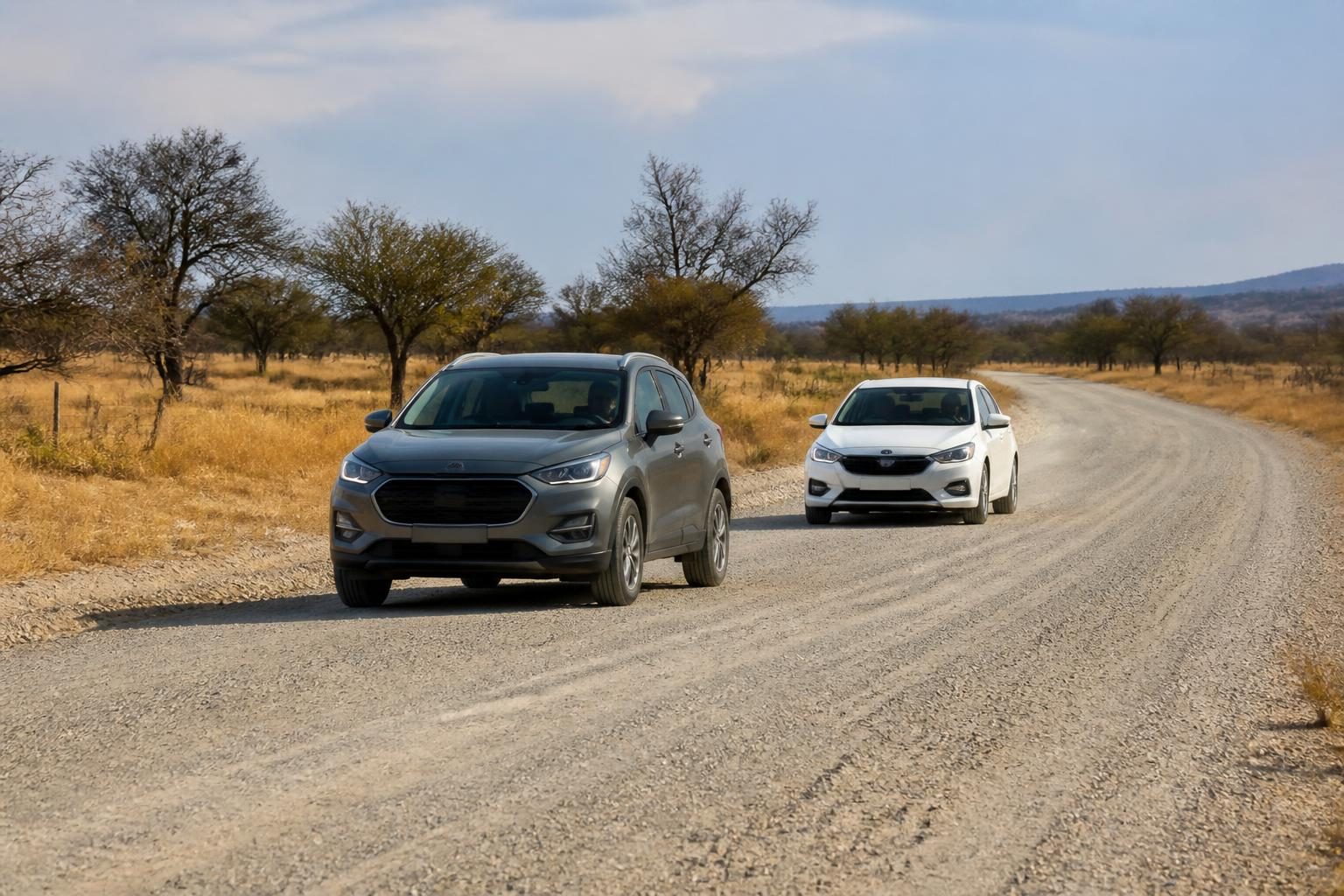 Two cars travel carefully on a broad gravel road in dry open countryside.
For a sedan example, read the Toyota Corolla Axio buying guide. For a crossover comparison, review the Toyota Yaris Cross listings, but check the exact drivetrain rather than assuming every example is 4WD.
Running Costs: SUV vs Sedan
A sedan is often cheaper to run because it may be lighter, more aerodynamic and fitted with smaller tyres. In 2024, gravel represented 33.3% of Botswana’s road network, according to Statistics Botswana’s Transport and Infrastructure Statistics Report 2024. Even fuel comparisons should allow for the extra load and rolling resistance of regular gravel driving.
Fuel is only one ownership cost. Larger SUVs may need wider tyres, stronger suspension components and more expensive drivetrain servicing. A compact hybrid crossover can narrow the gap, but the exact engine, model year, drivetrain and test cycle still matter.
Real-world fuel use changes with speed, passenger load, air-conditioning, tyre pressure, traffic and road surface. Official Japanese figures should be labelled as JC08 or WLTC. Do not compare figures from different cycles as if they were measured in the same conditions.
The safest comparison is qualitative:
| Cost area |
Sedan tendency |
Compact crossover tendency |
Large 4WD SUV tendency |
| Fuel |
Often lower |
Depends on engine and hybrid system |
Often higher |
| Tyres |
Often smaller |
Moderate |
Often larger |
| Suspension exposure |
Lower body may face more impacts |
More clearance, condition still matters |
Depends on design and use |
| Drivetrain complexity |
Usually simpler |
Varies widely |
May cost more with 4WD systems |
| Cargo flexibility |
Secure boot |
Flexible hatch |
Flexible and often larger |
| Purchase band |
Often lower |
Moderate |
Often higher |
In 2024, Statistics Botswana counted 11,208.7 kilometres of bitumen roads nationally, according to the report’s road-network data. For buyers who mainly use tarred town roads and highways, a lighter sedan may offer better value than paying for capability used only occasionally.
A lower fuel figure does not automatically make a sedan cheaper for every driver. Repeated underbody impacts, damaged tyres or suspension repairs can outweigh modest fuel savings if the car regularly faces rough routes.
Which Body Style Is Better for Families and Long Inter-Town Trips?
An SUV or crossover suits families carrying bulky luggage, while a sedan can be calmer and more economical when its cabin and boot provide enough space. In 2023, the WHO Global Status Report on Road Safety: Botswana profile listed a maximum rural speed limit of 80 km/h, making comfort and stable driving important on longer routes.
SUV and crossover advantages include a taller seating position, easier entry and exit, a wider hatch opening and more flexible loading. These features help when you carry cooler boxes, work equipment, prams or several bags.
A sedan offers a separate enclosed boot and may feel quieter and more settled on tar. It can also be easier to park in busy town areas. Do not assume a small crossover has more luggage room than a sedan. Boot shape matters.
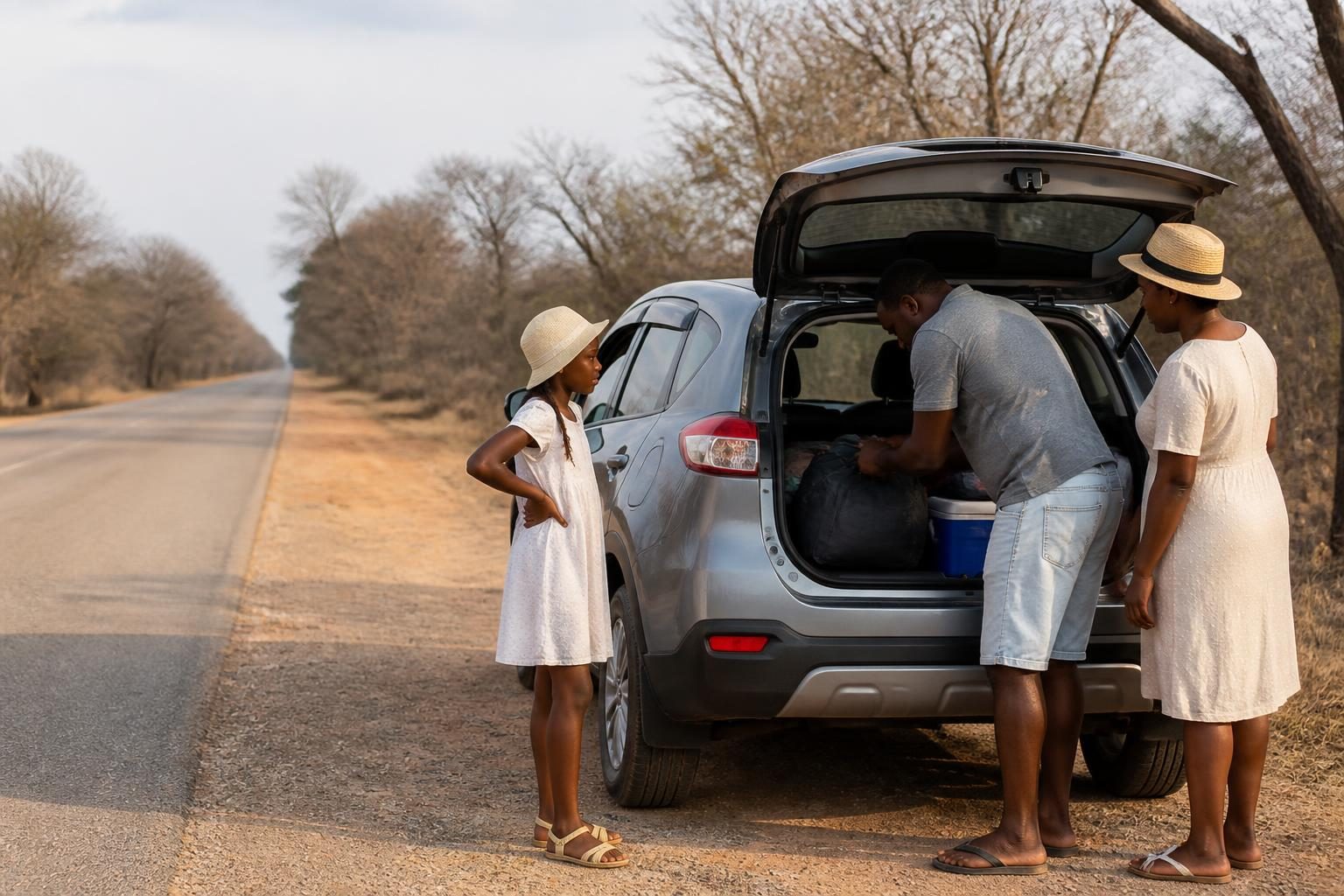 Family packs an SUV beside a quiet dry road under natural afternoon light.
Ask yourself a few practical questions. How many people travel regularly? Will you use child seats? Do you carry work tools or large shopping loads? Will luggage stay secure during a long inter-town trip?
The Toyota Corolla listing labels the 2022 vehicle as an SUV, but that classification may be a listing error because Corolla references distinguish sedan and hatchback body styles. Confirm the body style from the model code, photographs and manufacturer documentation before comparing dimensions or luggage capacity.
Before comparing any model, check the vehicle specifications for the precise body style, dimensions, engine and drivetrain.
What Should You Inspect Before Choosing Either Body Style?
Condition matters more than the badge. In 2023, the WHO Botswana profile listed maximum speed limits of 60 km/h in urban areas, 80 km/h in rural areas and 120 km/h on motorways. Higher ride height cannot replace sound tyres, brakes, suspension and sensible speed.
Which Inspection Details Matter on Rougher Routes?
Check the underbody for scrapes, impact damage and signs of poor repairs. Examine tyre age, tread and sidewalls, then confirm that the spare wheel and jack are present.
Listen for suspension noise and check whether the vehicle sits evenly. Review cooling-system condition, steering, braking and signs of flood or accident damage. These checks matter on both body styles.
For an imported vehicle, compare the auction grade with the detailed auction-sheet comments. Confirm the odometer, model code, engine size, fuel type and drivetrain. A lower odometer reading does not automatically mean better condition.
When reviewing Japanese inspection reports, underbody condition and tyres deserve as much attention as exterior paint. A clean-looking SUV with worn tyres may be a weaker gravel-road choice than a sound sedan.
Inspection records should be read as specific evidence, not as a general verdict on every SUV. Check the exact vehicle page for tyre tread, paint wear, auction grade and body-condition notes. Then consider those findings alongside mileage and drivetrain.
How Should Your Driving Pattern Decide?
A sedan makes sense if you:
- Mostly drive in town or on tarred highways.
- Want lower fuel and tyre costs.
- Carry passengers without bulky equipment.
- Can slow down on gravel roads.
A compact crossover makes sense if you:
- Regularly mix tar and maintained gravel.
- Want additional clearance and easier loading.
- Still need manageable town driving and fuel use.
A model-specific 4WD SUV makes sense if you:
- Frequently drive through deep sand or remote tracks.
- Need extra traction and clearance, confirmed from the exact drivetrain and equipment.
- Accept potentially higher fuel, tyre and maintenance costs.
For most buyers, the answer is a well-maintained sedan for mainly tarred driving or a compact crossover for mixed routes. Reserve a larger 4WD for a genuine capability requirement.
The Japanese import process explains how auction sheets, inspection reports and shipping documents fit into the purchase.
Comparing Japanese Sedans and SUVs for Botswana
Once you know which body style suits your routes, compare the exact vehicle’s evidence and estimated costs. In 2026, the How to Buy page states that buyers receive two reports, an official auction sheet and an in-house inspection report, before payment.
Carbarn’s Japanese vehicle sourcing service sources Japanese vehicles for buyers in Botswana. Its website identifies the operating company as Carbarn LLC in Japan. It should not be described as a Botswana dealership or showroom unless a local legal entity and premises are separately confirmed.
The listed vehicles are in Japan and are shipped by RoRo, typically through Durban, South Africa, with Walvis Bay also identified as an alternative port. The route then continues overland into Botswana.
Each vehicle page includes an estimate for the vehicle, shipping and inspection costs. Customs duty, VAT, clearance, registration and licensing are separate buyer costs, so this is not the final on-road total.
Carbarn currently uses an estimated customs-duty figure of about 27% of CIF on its import guidance page. CIF means the vehicle’s cost, insurance and freight value used in the import calculation. Treat this as an estimate only.
Duty, VAT and clearance charges vary by customs assessment. BURS assesses the final amounts using the applicable tariff, customs value and vehicle details. Confirm the current charges with BURS and the final pro forma invoice.
You can browse Japanese vehicles by body style and make, then review the individual vehicle page before deciding. The Botswana import rules page covers eligibility and documentation.