An electric car can be simple and inexpensive for a daily commute. Botswana’s distances make the buying question more complicated.
The issue is not only how far a Nissan Leaf can travel. It is where you can charge it afterwards. Nissan’s archived 2012 range page listed 200 km under the JC08 test cycle, while also warning that weather, traffic, air-conditioning and driving style change the result (Nissan Japan, Leaf Range, 2012).
This guide compares Leaf generations, battery evidence, charging standards and route suitability. It also explains why a newer registration year does not always mean a healthier battery.
Botswana vehicle import rules
Quick Answer
- A Nissan Leaf can suit daily Gaborone driving if you have reliable home charging.
- Nissan’s early Leaf range was listed as 200 km under the JC08 test cycle, but that is not guaranteed Botswana driving range (Nissan Japan, Leaf Range, 2012).
- Newer ZE1 and e+ variants offer a stronger starting point, but battery health matters more than age alone.
- Many Japanese Leafs use CHAdeMO for DC fast charging, so connector compatibility must be checked.
- The Leaf is mainly an urban, home-charging proposition rather than an automatic long-distance replacement.
Is the Nissan Leaf practical for everyday driving in Botswana?
In 2026, the live Nissan Leaf guide rated fuel efficiency 5/5 but road suitability 3/5 for Botswana (current Leaf guidance for Botswana, 2026). That combination describes the Leaf well: it can work brilliantly for predictable urban driving, but route planning matters outside town.
Gaborone commuting, shopping and school runs are the Leaf’s strongest use cases. Stop-start traffic can suit an electric car, especially when you begin each morning with a known battery reserve.
The key question is simple: can the car complete your longest regular day and still reach home or a confirmed charger? If yes, range anxiety may become a minor concern. If not, even a newer battery can feel inconvenient.
Speed, payload, hills, air-conditioning and battery age all reduce usable range. Nissan’s official range guidance says the displayed distance changes with weather, congestion, driving style and air-conditioning use (Nissan Japan, Leaf Range, 2012).
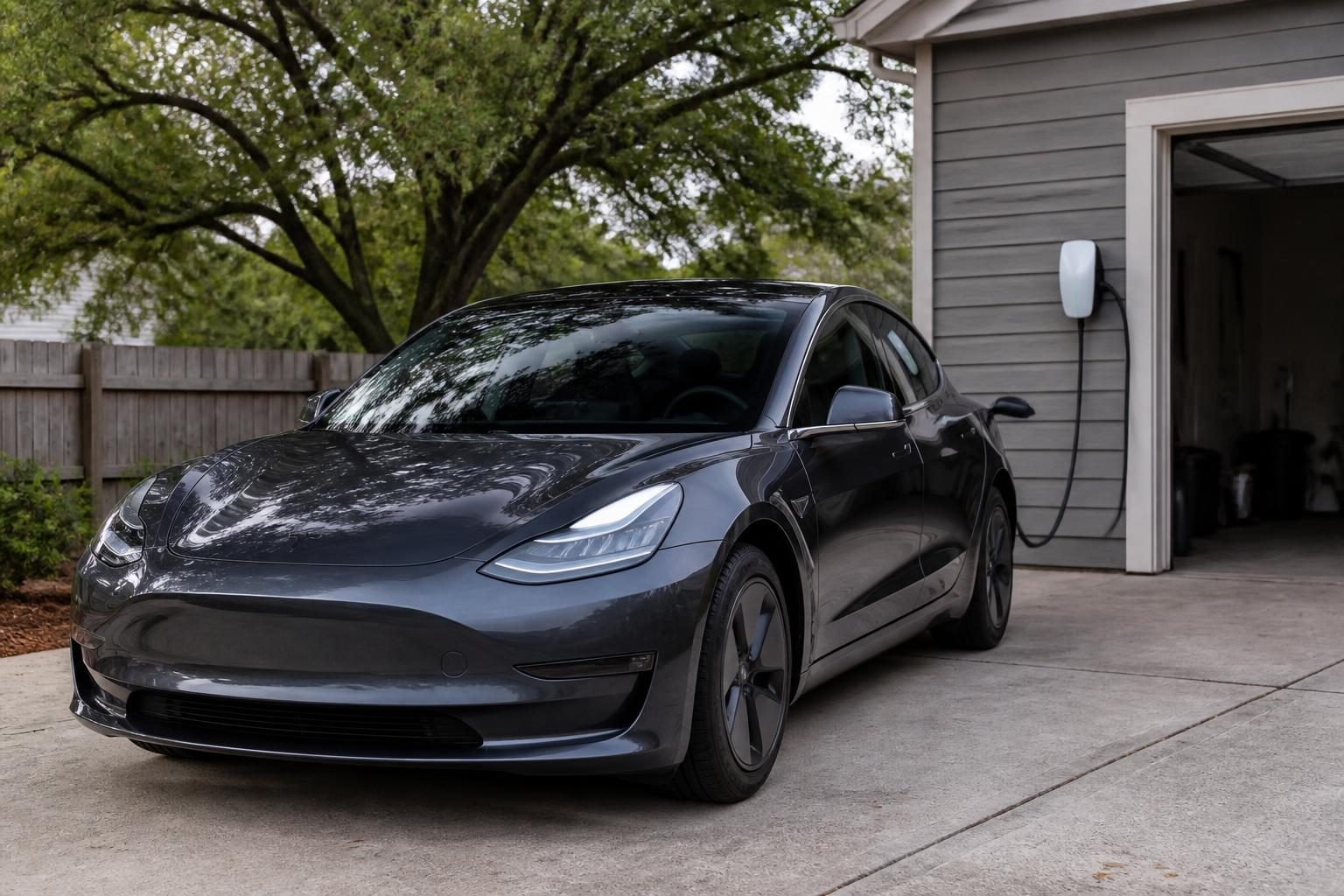 Electric car plugged into a home wall charger beside a garage.
Citation capsule: A Nissan Leaf is a practical urban electric vehicle when dependable home charging matches a predictable daily route. The Botswana guide rates its efficiency 5/5 but road suitability 3/5, making it stronger for commuting than uncertain inter-town travel. Nissan’s archived range page listed 200 km for an early Leaf under the JC08 test cycle, but also says weather, traffic, air-conditioning and driving style affect the displayed range (Leaf suitability guidance, 2026; Nissan Japan, Leaf Range, 2012). The practical implication is clear: choose the Leaf around your longest regular day, your charging routine and the availability of a safe reserve. A brochure figure alone cannot confirm that the car suits every Botswana route.
Nissan Leaf versions for a Botswana buyer
A 2017 Nissan Leaf is a useful middle-ground reference, while the live listings page showed 16 examples spanning 2013-2022 on 10 September 2026 (Botswana Nissan Leaf stock, 2026). That spread means buyers should compare battery evidence and model code, not only the registration year.
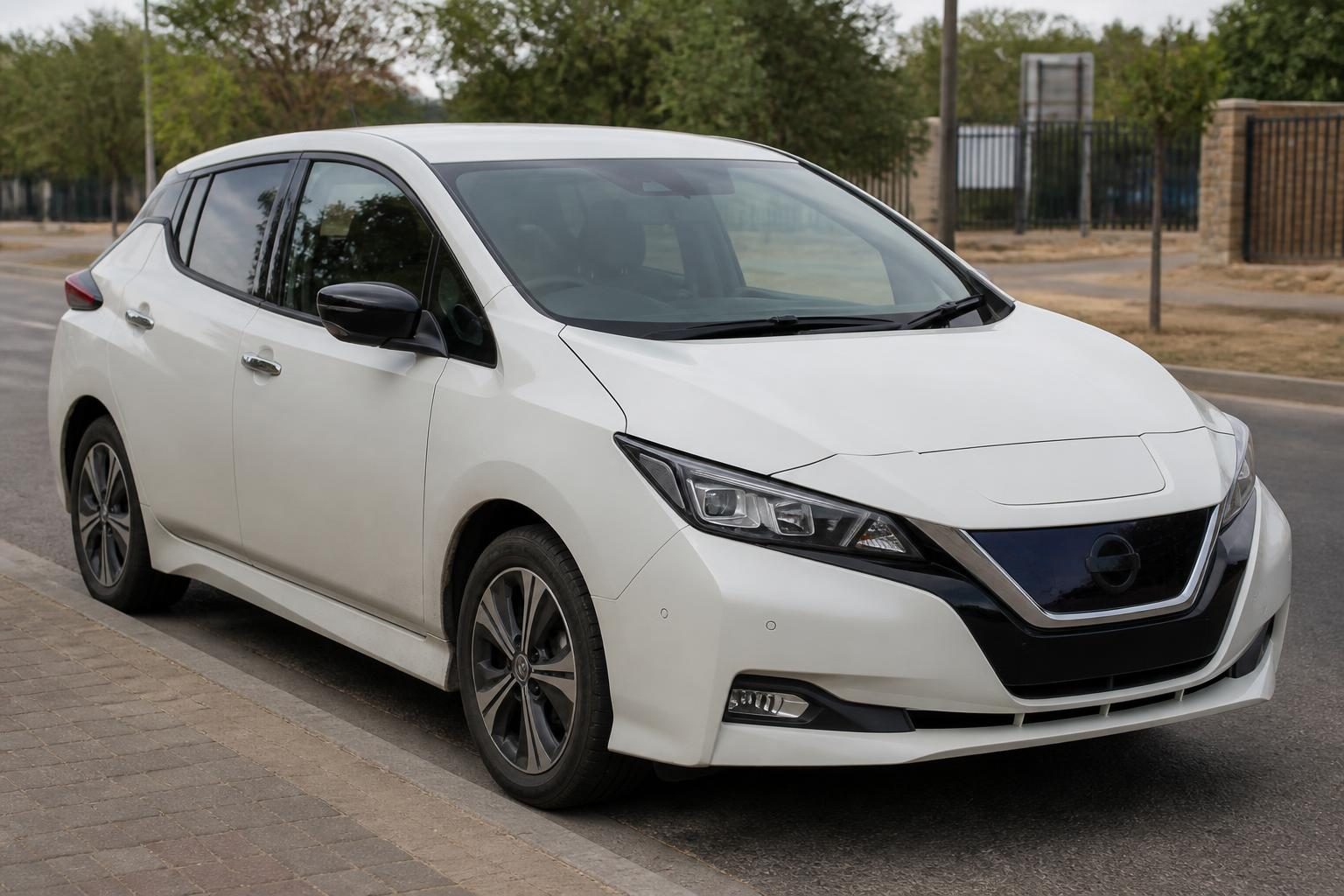 2020 Nissan Leaf vehicle listing
Older 2013-2015 Leafs are the lowest-entry choices, but they need the most careful battery inspection. Nissan’s archived page lists 200 km JC08 for the early Leaf (Nissan Japan, Leaf Range, 2012). Actual usable range depends heavily on battery condition, so these cars suit short urban routes with home charging only.
The 2018 Nissan Leaf example shows 69,000 km, grade 3.5, automatic transmission and 2WD. The 2017 example shows 61,000 km, grade 4.5, five seats and a clean underbody. These grades describe vehicle condition, not remaining battery capacity.
The selected 2020 Nissan Leaf shows 68,000 km, grade 4.5, an electric powertrain, automatic transmission, front-wheel drive and five seats. Its listed dimensions are 4,480 mm long, 1,790 mm wide and 1,560 mm high. The inspection records a clean underbody and 4 mm tyre tread, with minor bumper marks.
The stock record does not display state of health, horsepower, torque or a confirmed battery capacity. Those details should be checked before payment rather than guessed.
A 2022 Nissan Leaf shows 36,000 km, grade 4 and 2WD. Its inspection records a clean underbody, 5 mm tyre tread and minor exterior marks. The page does not expose detailed technical specifications. That is itself a reason to request the exact model code and battery information.
| Leaf group |
Best suited to |
Main strength |
Main concern |
| 2013-2015 |
Short urban routes |
Lower purchase band |
Battery age and limited reserve |
| 2017-2019 |
Daily commuting |
Potential middle ground |
Battery and variant differences |
| 2020-2022 ZE1 |
Regular urban use |
Newer platform and more reserve |
Higher purchase band |
| e+ variants |
Longer planned routes |
Larger battery family |
Confirm SOH and exact specification |
Citation capsule: Leaf listings spanning 2013-2022 show why buyers must compare battery generation, model code and documented condition. A grade 4.5 vehicle can have strong visible condition without proving battery capacity. Buyers should therefore request vehicle-specific battery-health evidence before relying on a listing. State of health (SOH) is a diagnostic estimate of remaining battery capacity compared with when the battery was new. It is different from an auction grade, odometer reading or registration year. The terms ZE0 and ZE1 identify different Leaf generations, while e+ identifies a larger-battery Leaf family or configuration. These labels help narrow the comparison, but they do not replace the exact vehicle’s battery records (Leaf import examples, 2026).
Nissan model specifications
Nissan Leaf range planning in Botswana
The CHAdeMO Association lists a specified 40 kWh Leaf at 400 km under Japan’s JC08 cycle, with approximately 40 minutes to charge to 80% using fast charging (CHAdeMO Association, Nissan Leaf, 2026). That figure applies to one configuration and must not be applied to every used Leaf.
JC08 is Japan’s older laboratory testing cycle. It helps compare vehicles, but it is not a guaranteed driving distance. JC08 and WLTC figures do not recreate every Botswana journey.
A tired battery, high speed, heavy load, hot weather or continuous air-conditioning can reduce the distance available. Plan around your longest normal day, not the largest brochure figure. Leave room for an unplanned stop and choose a route that ends at home or a confirmed charger.
What matters is not reaching zero. It is keeping a sensible reserve.
| Driving pattern |
Sensible planning approach |
| Short Gaborone commute |
Charge at home and start with a reserve |
| Commute plus errands |
Allow for air-conditioning and extra trips |
| Occasional inter-town travel |
Confirm destination charging first |
| Frequent long-distance travel |
Question whether the Leaf suits your only-car needs |
Citation capsule: Official Leaf range figures are configuration-specific test results, not promises of distance on Botswana roads. The CHAdeMO Association lists 400 km JC08 for a particular 40 kWh Leaf, while Nissan lists 200 km JC08 for an early Leaf and warns that weather, traffic, air-conditioning and driving style change the result (CHAdeMO Association, Nissan Leaf, 2026; Nissan Japan, Leaf Range, 2012). JC08 is an older Japanese laboratory cycle used for comparison. It does not account for every speed, load, temperature or route. For a Botswana buyer, the useful question is not which brochure number is largest. It is whether the exact vehicle can complete the longest regular journey while retaining a sensible reserve and reaching a confirmed charger.
Can you charge a Japanese Nissan Leaf in Botswana?
A specified 40 kWh Leaf can reach 80% in approximately 40 minutes using fast charging, according to the CHAdeMO Association (CHAdeMO Association, Nissan Leaf, 2026). The practical question is whether compatible equipment is available when and where you need it.
Home AC charging is the foundation of daily ownership. Confirm that your property can support a suitable dedicated circuit. Check that the charging equipment matches the vehicle, and keep a plan for power interruptions.
CHAdeMO is a DC fast-charging connector used by many Japanese-market Leafs. That does not prove that every public charger in Botswana will accept the car. Check the connector, charging speed, access requirements and destination availability before importing.
I could not verify an official operator-backed national map showing current CHAdeMO availability and uptime. Do not assume that Gaborone, Francistown, Maun or any inter-town route has dependable CHAdeMO access.
Range anxiety is often charging-planning anxiety. A reliable overnight routine may matter more than choosing the largest available battery.
Citation capsule: CHAdeMO is a DC fast-charging connector used by many Japanese-market Nissan Leafs, but connector compatibility does not prove that a public charger will be available or working at a particular Botswana destination. The CHAdeMO Association identifies a specified 40 kWh Leaf with fast charging and lists approximately 40 minutes to reach 80% (CHAdeMO Association, Nissan Leaf, 2026). That is a vehicle and charging-condition figure, not a national charging guarantee. Before importing, confirm the exact connector, the home installation, the charging speed and the access requirements for any destination charger. If no dependable public option can be verified, the Leaf should be planned as a home-charging vehicle. Overnight charging may be enough for predictable Gaborone use, but it does not remove the need to plan longer routes.
Home charging is the most dependable way to begin each day with a known reserve.
how the Japan-to-Botswana buying process works
What should you check before buying a used Nissan Leaf?
Botswana government guidance says vehicles more than three years old need roadworthiness testing before registration, and vehicle licences must be renewed annually (Government of Botswana, Vehicle Registration and Licencing, 2026). Those legal checks sit alongside a separate battery and condition inspection.
Use this checklist before committing:
- Battery state of health: Request documented SOH or diagnostic evidence. Do not infer it from the year.
- Exact model code: Confirm whether the car is ZE0, ZE1, e+ or another configuration. ZE0 and ZE1 identify different Leaf generations, while e+ identifies a larger-battery family or configuration.
- Battery capacity: Match the capacity to your longest regular route.
- Charging connector: Confirm the physical charging setup and planned equipment.
- Auction sheet: Check accident history, corrosion, water damage and warning lights.
- Inspection report: Review defects, underbody condition, tyres and suspension.
- Air-conditioning: Test it carefully because it affects comfort and range.
- Service support: Identify an EV-capable technician before purchase.
The live listings page showed odometers from 16,000 to 88,000 km and grades from 3.5 to 4.5 (current Leaf listings in Botswana, 2026). An odometer and auction grade are useful evidence, but neither proves remaining battery capacity.
Botswana registration also requires customs clearance. BURS says vehicles entering for home consumption should be cleared within 14 days and supported by customs, police and import documents (Botswana Unified Revenue Service, Clearance of Motor Vehicles, 2026).
Citation capsule: Battery condition should be assessed separately from visible vehicle condition. State of health (SOH) is a diagnostic estimate of remaining battery capacity compared with when new. It cannot be inferred reliably from an auction grade, odometer or registration year. Botswana’s current registration guidance requires roadworthiness testing for vehicles over three years old, while live Leaf listings show a wide 16,000-88,000 km range that cannot, by itself, prove battery health (Government of Botswana, Vehicle Registration and Licencing, 2026). A careful buyer should request the exact model code, battery capacity and documented SOH. The same check should confirm the charging connector, auction sheet, inspection report and access to an EV-capable technician before payment.
Who should buy a Nissan Leaf in Botswana, and who should skip it?
The Botswana guide rates Leaf resale value 2/5 and parts and service 2/5, while rating efficiency 5/5 (Leaf ownership guidance, 2026). These are commercial guidance indicators, not an independent national survey. They reflect the Leaf’s main trade-off.
A strong fit
- You mostly drive around Gaborone.
- Your daily route is predictable.
- You can charge at home overnight.
- You value quiet driving and low energy use.
- You have another vehicle for occasional long trips.
- You accept that specialist support may be needed.
A possible fit
- You travel between towns occasionally.
- You can charge at your destination.
- You choose a newer ZE1 or e+ variant.
- The vehicle has documented battery-health evidence.
- You confirm charging access before longer journeys.
A poor fit
- You have no dependable home charging.
- You regularly travel long distances.
- You need easy repairs anywhere.
- You want strong resale liquidity.
- You are choosing the cheapest older Leaf without battery evidence.
The verdict is straightforward. The Nissan Leaf is practical enough for everyday Botswana driving when your routine is urban, predictable and home-charging friendly. It is a weaker primary vehicle for frequent inter-town travel or uncertain charging access.
Citation capsule: The Nissan Leaf suits Botswana buyers who value efficiency and have dependable home charging. A 5/5 efficiency indicator sits beside 2/5 indicators for resale and parts support, so the Leaf should be chosen for route fit rather than low purchase cost alone (Leaf buyer guidance, 2026). These ratings are commercial guidance indicators, not an independent national survey. Their value is as a buying prompt: assess charging, route length, service access and battery evidence before comparing prices. A Leaf can make sense as an urban daily driver, but a buyer who frequently travels between towns should treat charging uncertainty and specialist support as central ownership issues, not minor details.
How should you compare Nissan Leaf listings for Botswana?
On 10 September 2026, the live Nissan Leaf page showed 16 listings from 2013 to 2022, with odometers between 16,000 and 88,000 km (current Leaf listings in Botswana, 2026). Availability changes, so the individual vehicle evidence matters more than a dated stock count.
Check the exact model code, battery capacity, odometer, auction grade, auction sheet, inspection report and any documented SOH. There is no single Nissan Leaf price in Botswana: the band changes with year, battery evidence, grade, mileage and shipping.
Open the vehicle page’s estimated landed-cost panel. The listed vehicle-and-shipping price is separate from customs duty, VAT, clearance, registration and licensing, which remain buyer costs. This article is a practicality guide, not a fixed price list.
Nissan Leaf vehicles available for Botswana
an individual Nissan Leaf vehicle page
Botswana eligibility and registration information
Nissan reference specifications
Carbarn's Japan vehicle import service lists Japan-sourced vehicles and provides the available auction and inspection documentation, vehicle-and-shipping pricing, an estimated landed-cost panel, proforma invoices and a self-service dashboard containing inspection sheets, bills of lading, certificates and vessel tracking. Sales and support run from Japan, with shipping by RoRo to Durban or, where arranged, Walvis Bay, followed by the buyer’s arrangements into Botswana. Full payment is required before shipment. The cited terms sell vehicles as-is and do not promise a manufacturer warranty; responsibility ends at the designated export port.